


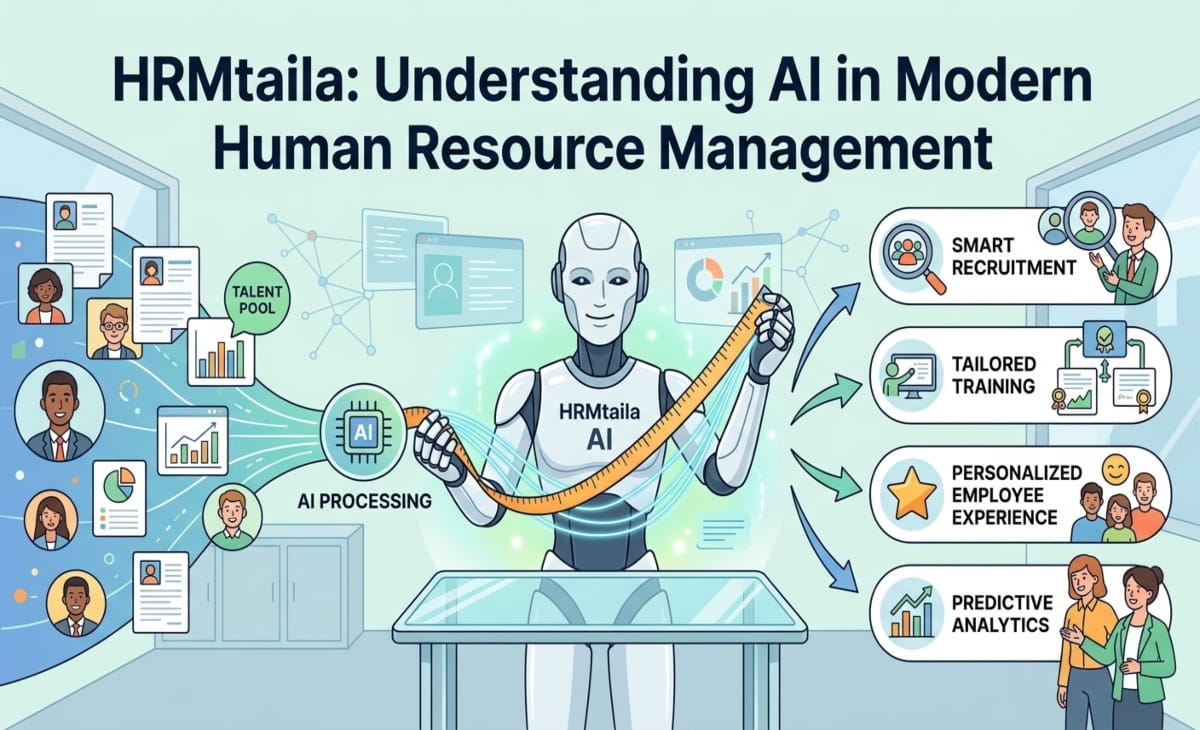
HRMtaila is an emerging online term associated with artificial intelligence and human resource management. It appears in discussions about AI-powered recruitment, employee support, HR automation, and workforce analytics.
Although the term is gaining attention online, HRMtaila has not been verified as an established software platform, company, or official HR technology standard. Its exact origin and intended meaning remain unclear.
This article explores what HRMtaila may refer to and how artificial intelligence is changing human resource management. It also examines the potential benefits, practical applications, limitations, and future of AI in HR.
What Is HRMtaila?
HRMtaila is an emerging term commonly associated with artificial intelligence and modern human resource management. However, it does not currently have a universally accepted or official definition.
Online discussions generally connect the term with technologies such as AI-powered HR software, automated administrative processes, cloud-based systems, and workforce analytics.
The main idea behind this concept is to make human resource operations more efficient through technology. HR departments manage many responsibilities, including recruitment, employee records, onboarding, payroll, leave management, training, and performance reviews.
AI-powered tools can help with some of these activities. For instance, they may organize job applications, send automatic reminders, prepare reports, or answer common employee questions.
These capabilities can reduce repetitive administrative work and allow HR professionals to focus on responsibilities that require personal attention.
However, these are general applications of AI in human resource management. They should not be considered verified features of an HRMtaila product because no established product has been confirmed.
Is HRMtaila a Real HR Platform?
At present, there is insufficient reliable information to confirm HRMtaila as a commercial human resource management platform.
No verified company or developer has been publicly identified as the creator of HRMtaila. Information about its founder, headquarters, management team, customers, or official product history is also unavailable.
Similarly, there are no confirmed details about subscription plans, pricing, mobile applications, integrations, or system requirements.
The meaning of the name is not entirely clear either. The letters HRM commonly stand for human resource management, but the complete term has no confirmed official explanation.
Some online articles associate HRMtaila with artificial intelligence and workplace automation. However, repeated descriptions across websites do not establish an official definition.
For now, HRMtaila is best understood as an emerging online keyword connected with AI and HR technology rather than a verified commercial software platform.
How AI Is Changing Human Resource Management
Human resource management has relied on digital systems for many years. Traditional HR software helps businesses maintain employee records, track attendance, manage leave, organize payroll information, and store important documents.
Artificial intelligence adds new ways to process and understand this information.
Modern AI tools can analyze large datasets, identify patterns, automate repetitive activities, and provide useful summaries. These capabilities can help HR departments manage their responsibilities more efficiently.
For example, recruitment software may organize job applications and help schedule interviews. Automated onboarding systems can remind new employees to complete important tasks, while virtual assistants can respond to routine questions about workplace policies.
The purpose of these technologies is generally to support HR professionals rather than replace them.
Human judgment remains essential in areas such as hiring, employee relations, performance reviews, and compensation. These decisions often require an understanding of individual circumstances that automated systems may not fully recognize.
AI in Recruitment
Recruitment is one of the most common areas where artificial intelligence can assist human resource departments.
Businesses sometimes receive hundreds of applications for a single position. Reviewing every application manually can require considerable time and effort.
AI-powered recruitment tools can help organize applications, identify relevant skills, and compare candidate information with job requirements. They may also help recruiters manage application records and track candidates throughout the hiring process.
Other recruitment activities can benefit from automation. Software may assist with preparing job descriptions, arranging interviews, sending reminders, and providing applicants with routine updates.
These features can make recruitment administration more manageable, particularly for organizations that regularly hire large numbers of employees.
However, automated recruitment systems have limitations. A candidate may have valuable experience that does not appear in the exact words or formats expected by the software. Automated assessments can also overlook important personal or professional circumstances.
For this reason, recruitment decisions should involve qualified human reviewers. AI can help organize information, but it should not be the sole authority determining whether a candidate is suitable for a position.
AI in Employee Onboarding
Employee onboarding is the process of helping new workers become familiar with an organization, its policies, and their responsibilities.
This process often involves several activities, including submitting documents, creating work accounts, completing training, reviewing company policies, and learning about employee benefits.
Automation can make these steps easier to organize.
An HR system may provide new employees with a checklist of required activities and show which tasks have been completed. It can also send reminders about missing documents, unfinished training, or upcoming deadlines.
AI assistants may help answer common onboarding questions. For example, a new employee might ask where to find a company policy, how to access a training course, or which form needs to be completed.
These tools can be particularly useful for businesses with remote employees or teams working across different time zones.
Nevertheless, onboarding should not depend entirely on automation. New employees may have personal concerns or complicated questions that require direct assistance from an HR professional.
A well-designed onboarding process should combine digital convenience with access to real human support.
AI Chatbots and Employee Support
HR departments regularly receive questions about workplace policies, leave entitlements, salary schedules, employee benefits, training opportunities, and internal procedures.
Many of these questions are repeated and relatively simple to answer. AI chatbots and virtual HR assistants can help employees find basic information without waiting for a personal response.
For example, an employee may use a chatbot to locate a leave policy or learn how to access an internal form. The system can provide information at any time, including outside normal office hours.
This can improve access to routine HR information while reducing the number of repetitive requests handled by HR staff.
However, chatbots are not suitable for every employee concern. Workplace disputes, complaints, complicated payroll problems, and sensitive personal matters may require a detailed conversation with a qualified professional.
An AI assistant may misunderstand a question or fail to recognize the circumstances behind it.
Organizations should therefore provide a clear way for employees to contact a real HR representative whenever automated assistance is insufficient.
Workforce Analytics and Planning
Human resource departments collect large amounts of information about their workforce. This may include employee attendance, turnover, recruitment activity, training, skills, staffing levels, and labor costs.
Workforce analytics involves examining this information to understand patterns and support organizational planning.
AI can help process large datasets and identify trends that might otherwise be difficult to notice. For example, an organization may discover that a particular department has a higher employee turnover rate than others.
Workforce analytics may also help identify skill shortages, changing staffing requirements, or areas where additional training could be useful.
Predictive analytics can examine historical information to identify patterns that may indicate future workforce challenges. These insights can help managers prepare for possible recruitment or training needs.
However, predictions should not be treated as guaranteed outcomes. If employees are leaving a particular department, the available data may not explain the reasons.
Turnover could be connected to workload, management practices, compensation, career opportunities, or other factors.
Managers should investigate these circumstances instead of relying entirely on automated reports. Workforce analytics is most useful when it supports informed decisions and is combined with human understanding.\
You May Also like this: MMSBRE: Meaning, Uses, and Its Connection to Digital Technology
Payroll, Records, and HR Automation
Managing employee information is an important part of human resource administration. HR teams often handle attendance records, leave requests, overtime, salary details, employment documents, and other sensitive information.
When employees’ details have to be entered into multiple systems manually, administrative work can become time-consuming. Repeated data entry can also increase the possibility of mistakes.
Automation can help connect different HR processes and reduce unnecessary manual work. For example, connected systems may transfer attendance and leave information to other parts of an HR platform.
Automated tools can also identify missing information, flag unusual entries, and help prepare routine reports.
Payroll is another area where automation can be useful. Systems may collect relevant information about attendance, overtime, leave, and salary details to support payroll processing.
Cloud-based HR platforms can keep employee records in a centralized location. Access controls can help ensure that only authorized people can view or update sensitive information.
However, automation does not guarantee accurate payroll or employee records. Organizations still need appropriate checks to identify incorrect data and prevent administrative errors.
These are general capabilities of HR technology and should not be presented as confirmed features of HRMtaila.
AI in Performance Management
Performance management involves reviewing employee goals, work results, feedback, and development needs.
AI can help HR teams and managers organize performance-related information. Some systems can bring together project results, employee goals, and feedback to make information easier to review.
These tools may also help identify areas where an employee could benefit from additional training or support.
For example, a manager might use an HR system to review progress toward agreed objectives before conducting a performance discussion.
However, employee performance cannot always be measured accurately through numbers. Some responsibilities involve teamwork, problem-solving, creativity, or other contributions that are difficult to quantify.
Automated systems may also overlook changes in workload, difficult assignments, or personal circumstances that affect an employee’s work.
AI should therefore support performance reviews rather than make final judgments. Managers need to consider relevant information, communicate directly with employees, and use their professional judgment when making important decisions.
Benefits of AI in HR
Artificial intelligence and automation can offer several benefits when applied to suitable human resource activities.
One major advantage is time savings. Software can help manage repetitive tasks such as organizing records, scheduling interviews, sending reminders, and preparing routine reports.
Automation can also make certain processes more consistent. When systems follow defined procedures, they can help HR teams track tasks and reduce some common administrative errors.
Another potential benefit is faster access to employee information. AI-powered assistants can answer routine questions and direct workers to relevant policies or resources without requiring them to wait for an email response.
Workforce analytics can also help organizations understand hiring trends, employee turnover, staffing requirements, and training needs. These insights may support better planning.
Perhaps most importantly, reducing repetitive administrative work can give HR professionals more time to focus on people. They can devote greater attention to recruitment, employee development, workplace concerns, and other responsibilities that require personal interaction.
The benefits depend on how the technology is selected, implemented, and monitored. AI is not automatically effective simply because it is introduced into an HR department.
Risks and Limitations
Despite its potential benefits, artificial intelligence has important limitations in human resource management.
AI systems can produce inaccurate information, misunderstand instructions, or generate unsuitable recommendations. Their results may also be affected by the quality of the data they receive.
Incomplete, outdated, or incorrect employee information can lead to unreliable outputs. Organizations need to check the information used by their systems and review important results.
Another limitation is the difficulty of understanding individual circumstances. Two employees may have similar performance figures but face very different working conditions. An automated system may not recognize those differences.
There is also a risk of excessive dependence on technology. Managers should not assume that an automated recommendation is correct simply because it comes from a computer system.
Some AI tools may also make it difficult for employees to understand how a result was produced. This can become particularly important when technology is used in decisions affecting someone’s job or career.
Organizations should understand how their AI systems work, establish clear responsibilities, and ensure that important decisions receive suitable human review.
Bias and Fairness in HR AI
Fairness is a major concern when artificial intelligence is used in employment-related activities.
AI systems may learn from historical information or follow rules designed by people. If that information contains unfair patterns, the system may reproduce or reinforce them.
For example, historical recruitment records may reflect unequal opportunities or biased hiring practices. A system trained on such records could produce recommendations that disadvantage certain candidates.
Similar concerns may arise when AI is used for promotion decisions, performance evaluations, compensation, or other employment processes.
Businesses should regularly examine automated results to identify possible patterns of unfair treatment. Important systems should also be tested before they are used for significant employment decisions.
Human oversight is especially important when automated recommendations could affect a person’s employment opportunities.
Candidates and employees should be assessed using relevant information rather than being reduced to a single automated score. Fair processes require organizations to consider context and review how their systems affect different people.
Employee Data Privacy and Security
Human resource departments handle sensitive information about employees and job applicants. This can include contact details, employment history, CVs, salary information, attendance records, and performance evaluations.
Introducing AI into HR processes can create additional questions about how this information is collected, stored, accessed, and used.
Before adopting an AI tool, a company should understand what employee information the system needs and why it requires access to that data.
Organizations should also review where information is stored, who can access it, how it is protected, and how long it is retained.
Access permissions should be limited to people who genuinely need the information for their work. Strong security measures are particularly important when cloud platforms or external software providers are involved.
Businesses must also consider the privacy and employment requirements that apply in the locations where they operate.
Privacy should be part of the planning process from the beginning. Waiting until after employee information has been added to a system can create avoidable risks.
How Businesses Can Use AI in HR Responsibly
Businesses do not need to automate every human resource activity at the same time. A gradual approach can help organizations understand whether a particular tool is useful.
The first step is to identify a specific problem. A company might choose to improve interview scheduling, onboarding administration, routine employee questions, or basic HR reporting.
The organization can then test a suitable tool with a small group of users. During this stage, HR professionals should check whether the system saves time, provides accurate information, and is easy for employees to use.
Testing should also include reviewing mistakes and identifying situations where the software cannot provide a suitable answer. A tool that produces frequent errors may create additional work rather than reduce it.
Employees and HR staff should understand what the system can do and where its limitations begin. Training can help prevent people from relying too heavily on automated recommendations.
Businesses should also establish which activities require human involvement. Sensitive employee concerns and high-impact employment decisions need appropriate oversight.
For larger projects, HR teams may need to work with IT, management, security, legal, or privacy specialists. Cooperation between these teams can help ensure that AI tools are suitable, secure, and aligned with organizational needs.
Why Human Review Still Matters
Human resource management deals with people’s jobs, income, careers, and workplace experiences. These responsibilities often require careful judgment and an understanding of individual circumstances.
AI can help organize information, automate routine activities, and identify possible patterns. However, it cannot fully understand every employee’s situation.
There is an important difference between using AI to assist with a task and allowing it to make a decision independently. A system that organizes job applications, for example, is different from one that automatically decides which candidates should be hired.
Important decisions involving recruitment, pay, performance, disciplinary action, or termination should include appropriate human review.
Employees should also have a clear way to speak with a real person if an automated system provides incorrect information or fails to understand their concern.
Introducing AI does not remove an organization’s responsibility for its decisions. Businesses remain accountable for how their technology is used and how employees are treated.
Future of AI in Human Resource Management
Artificial intelligence is expected to remain an important part of HR technology. Future systems may connect more human resource activities and make information easier to access across different departments.
AI assistants may increasingly support routine activities involving recruitment, onboarding, employee support, training, and administration.
Workforce analytics may also become more accessible. HR teams could use these tools to examine staffing patterns, identify skill gaps, and plan employee development.
Businesses may also use AI to recommend relevant training based on employees’ roles, skills, or development goals. Predictive tools could help managers identify potential staffing challenges earlier.
Employee self-service may continue to develop as well. Workers may be able to access policies, complete routine HR tasks, and find answers through digital assistants.
However, greater automation does not mean that every HR decision should be made by AI. Recruitment, compensation, performance management, and employee relations will continue to require suitable human involvement.
The future of HRMtaila specifically remains uncertain. There is not enough reliable information to determine whether it will become a recognized HR term, remain an online keyword, or eventually be associated with a particular product or project.
Any claims about its future development should be checked against reliable information from an identifiable source.
Bottom Line
HRMtaila is an emerging online term associated with artificial intelligence and human resource management. It is commonly discussed in connection with recruitment, employee onboarding, HR automation, workforce analytics, and digital employee support.
However, there is currently insufficient reliable evidence to confirm HRMtaila as an established software platform or company. Its creator, official definition, product history, and commercial details remain unknown.
The broader technology associated with the term is already being used in HR. AI can help organizations reduce repetitive work, organize employee information, support routine questions, and analyze workforce data.
At the same time, businesses need to consider potential problems involving inaccurate information, bias, employee privacy, and excessive reliance on automated decisions.
A responsible approach combines useful technology with strong data protection, regular monitoring, clear procedures, and human judgment.
Frequently Asked Questions
What is HRMtaila?
HRMtaila is an emerging online term associated with AI-powered human resource management. It is discussed in relation to recruitment, onboarding, employee support, automation, and workforce analytics.
Is HRMtaila a real software platform?
There is currently no reliable evidence confirming HRMtaila as an established commercial HR software platform. It is better understood as an emerging online term until more information becomes available.
Who created HRMtaila?
The creator of HRMtaila has not been reliably identified. Its exact origin and official meaning remain unclear.
How can AI help HR teams?
AI can assist HR teams with recruitment administration, employee onboarding, routine questions, reporting, workforce analytics, and other repetitive activities.
Can AI replace HR employees?
AI can automate some administrative tasks, but it cannot fully replace the human judgment required for sensitive employee matters, workplace relationships, and important employment decisions.
Is AI safe for employee data?
AI tools can be used with appropriate privacy and security safeguards. Businesses should understand what data a system collects, who can access it, and how the information is protected.
Can AI be biased when hiring employees?
Yes. AI systems can produce unfair results when their training data or decision-making rules contain bias. Regular testing and human review can help identify and reduce these risks.
Can small businesses use AI for HR?
Yes. Small businesses can use AI tools for activities such as interview scheduling, onboarding, routine employee questions, and basic reporting. They should select tools that suit their needs and protect employee information.
