


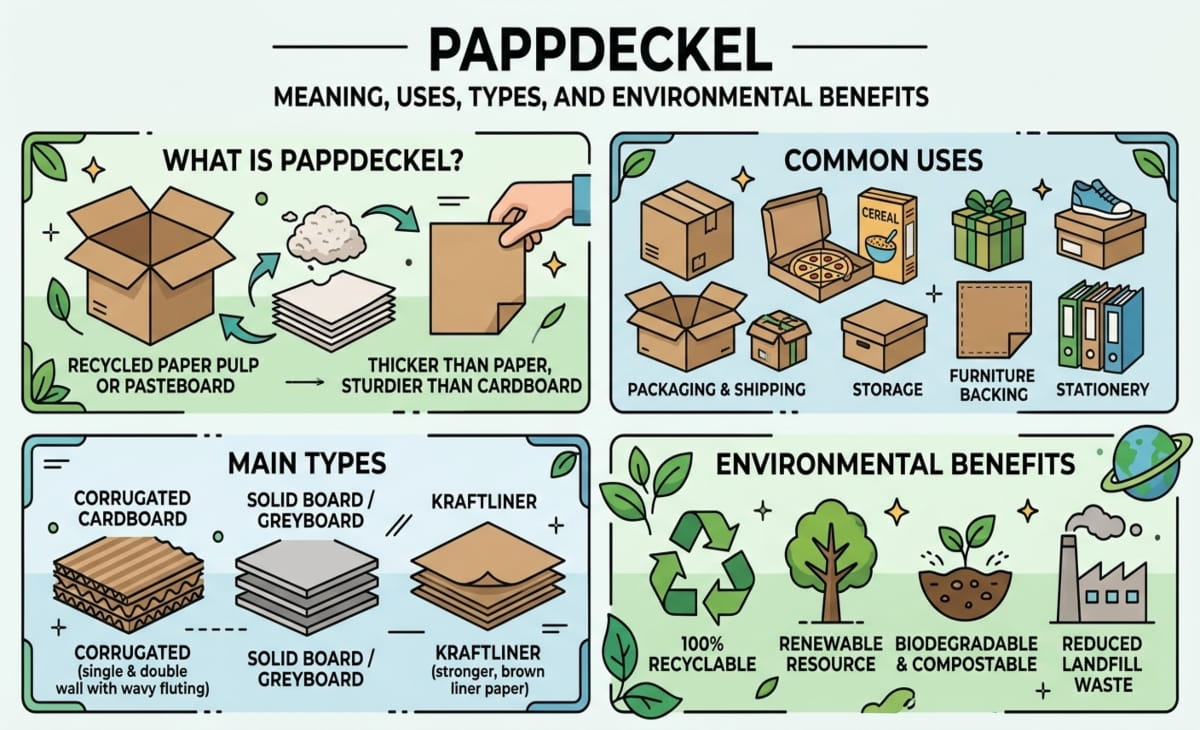
Everyday materials often have a greater impact on modern life than people realize. One example is Pappedeckel, a German term associated with cardboard, stiff paperboard, and compressed paper materials. Although the word may be unfamiliar to people outside German-speaking countries, the material it describes is widely used in packaging, bookbinding, arts and crafts, and protective applications. Its affordability, versatility, and practical strength make it useful for households, manufacturers, designers, and businesses. As interest in sustainable materials and responsible packaging continues to grow, understanding how cardboard products are produced, used, and recycled has become increasingly important.
This article explores what Pappedeckel means, where the term comes from, how the material is manufactured, its common types, everyday applications, environmental advantages, and practical limitations. It also explains how to select the right cardboard for different purposes and why choosing an appropriate material is essential for achieving good results.
What Is Pappedeckel?
Pappedeckel is a German expression generally associated with cardboard, stiff paperboard, or a piece of thick cardboard used as a cover or protective surface. Related spelling forms include Pappendeckel and Pappdeckel. The most suitable English translation depends on the context in which the word appears. It may describe a simple sheet of cardboard, a rigid cover, a protective board, or a cardboard coaster.
Rather than identifying one specific commercial product or patented material, the term covers a range of cardboard-based items. These products are generally made from paper fibers pressed into a firm structure. Their thickness, density, surface texture, and strength vary according to their intended use. Some cardboard sheets are lightweight and easy to cut, while others are rigid enough to support book covers, presentation boxes, and protective packaging.
This versatility explains why Pappedeckel-related materials are found in many different environments. From household projects to industrial packaging, cardboard provides a practical combination of accessibility, adaptability, and structural support.
The Meaning and Origin of Pappedeckel
The meaning of Pappedeckel becomes easier to understand when its German word components are considered. Pappe refers to cardboard or pasteboard, while Deckel commonly means a lid or cover. Although the combined word may suggest a cover or lid, its everyday usage can extend beyond that literal meaning.
In German-speaking regions, including parts of Austria and Bavaria, the term may be used in connection with ordinary cardboard pieces, protective sheets, or materials used in handmade objects. Its precise meaning can vary depending on the situation, local vocabulary, and the product being discussed.
The word may also appear in contexts involving cardboard beverage coasters. However, the more specific German term for a beer coaster is Bierdeckel. Understanding this distinction can help readers interpret German product descriptions, craft instructions, and regional expressions more accurately.
Because Pappedeckel is a broad material-related term, it should not automatically be treated as the name of a single brand, manufacturing process, or standardized product. The surrounding context is important when determining exactly what it describes.
How Is Pappedeckel Made?
The production of sturdy paperboard generally begins with cellulose fibers obtained from wood pulp, recovered paper, or a mixture of both. These fibers are combined with water to form a pulp that can be spread into sheets. During manufacturing, the water is removed, and the material is pressed and dried until it develops the desired thickness and structure.
Some paperboard products are manufactured in multiple layers to improve rigidity or provide specific surface characteristics. Depending on the intended application, manufacturers may also add printing, decorative coverings, adhesives, or functional coatings. These finishing processes can influence the material’s appearance, durability, and suitability for different environments.
For example, cardboard used in bookbinding usually needs enough stiffness to maintain the shape of a cover. Packaging board, on the other hand, may need to balance rigidity with the flexibility required for folding and assembly.
The final characteristics depend on several factors, including fiber quality, density, thickness, layering, and finishing treatments. As a result, two products described as cardboard may perform very differently when exposed to pressure, moisture, or repeated handling.
Common Types of Pappedeckel Materials
Solid and Grey Paperboard
Solid paperboard is commonly used when a flat and relatively rigid structure is required. Greyboard, in particular, is widely associated with bookbinding, storage boxes, presentation materials, and protective panels.
Its firm structure provides support without requiring a complicated construction process. The surface can be covered with printed paper, fabric, decorative sheets, or other suitable materials to achieve a finished appearance.
This type of board is useful for hardcover books, notebooks, folders, gift boxes, and display products. Its performance depends on its thickness and density, so the appropriate grade should be selected according to the weight and structural demands of the finished item.
Coated and Decorative Cardboard
Some cardboard products feature smooth, coloured, printed, or specially treated surfaces. These materials are useful when presentation is just as important as functionality.
Coated cardboard can provide a better printing surface and may offer certain protective properties, depending on the treatment used. Decorative board is often selected for retail packaging, invitations, display materials, and creative projects.
However, a smooth or attractive finish does not automatically make cardboard waterproof, suitable for direct food contact, or recyclable through every local collection system. The type of coating and the material’s intended purpose should always be considered before use.
Recycled Paperboard
Recycled paperboard is manufactured using recovered paper fibers. It can be an effective option for packaging, protective inserts, craft projects, and other applications where its particular strength and surface characteristics are suitable.
Its appearance and performance depend on the quality of the recovered fibers and the manufacturing process. Some grades may have a less uniform surface than products made with different fiber compositions, but this does not prevent them from being useful for many everyday purposes.
Using recycled fibers can reduce demand for fresh raw materials. Nevertheless, the overall environmental impact also depends on manufacturing energy, transportation, product lifespan, and the options available for recycling the finished material.
Everyday Uses of Pappedeckel
One of the main reasons cardboard remains popular is its ability to serve many purposes. Packaging is among its most common applications. Cardboard sheets and boards are used to make boxes, dividers, covers, and internal supports that help protect and organize goods during storage and transportation.
Another major application is bookbinding. Hardcover books, diaries, folders, and presentation materials often contain rigid boards beneath their outer coverings. These boards help the finished product retain its shape while providing protection for its contents.
Artists, designers, and manufacturers also use cardboard for display panels, picture mounts, presentation models, and lightweight structural components. Its ability to be cut and shaped makes it convenient for creating prototypes before investing in more expensive materials.
In homes and schools, cardboard is frequently used for educational activities and practical projects. Children may use it to build models, while hobbyists turn it into handmade cards, decorative objects, storage organizers, and miniature buildings.
Cardboard beverage coasters are another familiar example. These simple items demonstrate how a relatively inexpensive material can provide a useful protective surface in everyday settings.
Why Pappedeckel Is Useful in Modern Packaging
Modern packaging must protect products while remaining economical to manufacture, transport, store, and handle. Paperboard can meet many of these requirements because it is relatively lightweight, easy to cut into different shapes, and often suitable for printing.
Its stiffness can help packaging retain its form and keep individual products separated. Depending on the grade and design, cardboard inserts can also reduce unnecessary movement inside a box and provide support during handling.
For businesses, customizable cardboard packaging offers an opportunity to combine practical protection with product presentation. Printed surfaces can display branding, product information, instructions, and other details. Custom inserts can help keep smaller items in position, while carefully designed boxes can improve the overall appearance of a product.
However, the material must match the requirements of the goods being packaged. Heavy, fragile, wet, or temperature-sensitive products may need stronger structures or additional protective materials. Ordinary paperboard should not be assumed to provide a reliable barrier against moisture, liquids, or physical impact.
The best packaging solution is one that balances protection, cost, material use, and the needs of the product throughout transportation and storage.
Creative Uses in Art, Crafts, and Home Projects
Pappedeckel-related materials are popular among creative people because cardboard is widely available, comparatively inexpensive, and relatively easy to work with. A rigid sheet can serve as the base for miniature buildings, handmade photo frames, decorative signs, display boards, and storage compartments.
Designers often use cardboard to test shapes, dimensions, and construction methods before producing a finished item from more expensive materials. It can also be useful for school assignments, craft demonstrations, and small-scale model making.
For home organization, cardboard panels can be cut into drawer dividers, document separators, lightweight organizers, and storage inserts. With appropriate coverings and careful assembly, simple cardboard pieces can become practical additions to a room or workspace.
The quality of a finished project depends on more than the material itself. Accurate measurements, clean cutting, suitable adhesives, and the correct board thickness all contribute to a stronger and more attractive result.
Although cardboard may not provide the durability of wood, metal, or certain plastics, it can be a useful choice for lightweight projects that do not require high load-bearing capacity or prolonged exposure to moisture.
Environmental Benefits and Sustainability
One reason paperboard receives attention is its potential role in sustainable packaging. Paper fibers come from renewable biological resources, and many cardboard products can be recovered through established paper-recycling systems. Reusing recovered fibers in new products can also help keep materials in circulation.
Cardboard may be particularly useful when packaging is designed to use fewer materials, avoid unnecessary components, and fit efficiently around the product. Lightweight packaging can also offer practical advantages during storage and transportation, although the overall environmental effect depends on the specific supply chain.
Nevertheless, cardboard should not automatically be considered environmentally harmless. Its production requires water, energy, raw materials, and transportation. Certain coatings, adhesives, inks, and combinations of different materials may also make recycling more difficult.
Food residue and other contamination can affect whether a used cardboard product is accepted by a local recycling service. Similarly, not every coated or laminated board can be processed through the same recycling system as clean, uncoated cardboard.
The environmental value of paperboard therefore depends on how it is sourced, manufactured, used, and disposed of. Reducing unnecessary packaging, encouraging reuse where practical, and improving recyclability are important steps toward more responsible material use.
Choosing cardboard over another material does not guarantee a lower environmental footprint in every situation. The most appropriate option depends on the product’s requirements and the full lifecycle of the packaging.
Is Pappedeckel Suitable for Food Packaging?
Cardboard-based materials can be used for food packaging, but not every cardboard sheet is safe for direct contact with food. Materials intended for food use must meet the applicable safety requirements for their intended conditions of use.
Manufacturers and businesses need to consider whether substances from the fibers, inks, adhesives, coatings, or other components could transfer into food. This is especially important when packaging is intended for hot, moist, or fatty foods, as these conditions may affect material performance and the potential for substance migration.
In the European Union, food-contact materials are subject to general safety requirements intended to protect consumers. Businesses should obtain appropriate product specifications and compliance documentation from their suppliers rather than assuming that every paper-based product is suitable for food use.
Ordinary craft cardboard should not be used as a substitute for verified food-contact packaging. If the material will touch food directly, it is important to select a product specifically designed and documented for that purpose.
How to Choose the Right Pappedeckel
Selecting the right type of Pappedeckel begins with identifying the task it needs to perform. Thickness and rigidity are important when choosing board for book covers, presentation materials, storage boxes, and protective packaging. Thinner grades are often easier to cut or fold, while thicker grades may offer greater structural support.
However, thickness alone does not determine strength. Fiber composition, density, layering, and manufacturing quality can also affect how a board performs under pressure or during repeated use.
The surrounding environment is another important consideration. Projects exposed to moisture may require specially treated materials, while decorative applications may benefit from a smooth surface that accepts printing, paint, or adhesive coverings.
Before purchasing, consider the following factors:
- Purpose: Decide whether the material will be used for packaging, bookbinding, decoration, or structural support.
- Thickness and strength: Match the board’s rigidity to the weight and demands of the finished product.
- Surface finish: Choose a suitable texture or coating for printing, painting, or covering.
- Moisture exposure: Check whether the board can withstand the conditions in which it will be used.
- Dimensions and cutting quality: Ensure the material can be processed into the required shapes and sizes.
- Cost and availability: Compare prices while considering the amount of material needed and the expected performance.
- Recyclability: Check whether the finished product can be accepted by local recycling facilities.
For commercial applications, requesting samples before placing a large order can help confirm whether the selected board meets the project’s requirements.
Limitations and Common Problems
Despite its many advantages, cardboard has limitations that should be considered before use. Sensitivity to moisture is one of the most common problems. Untreated cardboard can absorb water, lose stiffness, warp, or deteriorate in damp conditions.
Repeated bending and handling can also weaken certain grades, especially along folds, edges, or areas exposed to concentrated pressure. Lightweight board may be unsuitable when a project requires long-term structural stability or support for heavy objects.
Cardboard is not always appropriate for prolonged outdoor exposure, demanding mechanical loads, or applications that require a dependable barrier against liquids. Protective coatings can improve some properties, but they may increase the cost and complicate disposal or recycling.
Another potential problem is choosing a product based only on appearance or price. A decorative board may look sturdy but fail to provide sufficient support for a particular application. Similarly, a recycled board may be environmentally attractive but still need to meet specific strength, cleanliness, or surface requirements.
Consumers and businesses should evaluate the complete purpose of the product before making a selection. Understanding these limitations helps prevent material failure and reduces unnecessary waste.
The Future of Cardboard-Based Materials
The future of cardboard-based materials is closely connected with packaging design, resource efficiency, and manufacturing innovation. Producers continue to explore methods for improving strength, reducing unnecessary material, and developing treatments that meet practical performance requirements.
For businesses, an important opportunity lies in designing packaging that uses only the amount of material needed to protect a product. Better sizing, efficient folding structures, and simplified combinations of materials may help reduce waste and make packaging easier to handle after use.
Recycled fibers and improved recovery systems may also contribute to more efficient material use. At the same time, product designers need to balance performance, cost, and recyclability rather than focusing on a single environmental feature.
Cardboard is unlikely to replace every alternative material. Some applications require stronger, more durable, or more moisture-resistant solutions. However, thoughtful design and appropriate material selection can ensure that paperboard continues to play a valuable role in manufacturing, packaging, and everyday life.
Final Words
Pappedeckel describes a versatile family of cardboard-based materials used in packaging, bookbinding, creative projects, protective applications, and household organization. Its usefulness comes from a practical combination of affordability, adaptability, and structural strength. The German term can refer to several related objects rather than one specific product, making context important when interpreting its meaning.
As interest in responsible material use grows, paperboard remains a useful option for consumers, designers, and businesses. Its benefits are greatest when the right grade is selected, relevant safety requirements are followed, and disposal options are considered from the beginning.
Ultimately, the value of Pappedeckel lies not simply in its simplicity, but in choosing and using the material intelligently. When its capabilities and limitations are understood, cardboard can provide a practical solution for many everyday needs.
Frequently Asked Questions (FAQs)
1. What does Pappedeckel mean in English?
Pappedeckel is a German term associated with cardboard, stiff paperboard, or a piece of thick cardboard. Depending on the context, it may also describe a cardboard cover or coaster. Related spelling forms include Pappendeckel and Pappdeckel.
2. What is Pappedeckel commonly used for?
Pappedeckel-related materials are used for packaging, bookbinding, craft projects, protective boards, presentation boxes, and cardboard coasters. The most suitable application depends on the material’s thickness, strength, surface finish, and intended use.
3. Is Pappedeckel environmentally friendly?
Paperboard can offer environmental benefits when responsibly sourced, efficiently manufactured, reused where practical, and recycled through suitable systems. However, its overall impact depends on factors such as energy use, transportation, coatings, contamination, and disposal options. It is not automatically sustainable in every application.
4. Can Pappedeckel be recycled?
Many clean, uncoated cardboard and paperboard products can be recycled through paper-recovery systems. However, certain coated, laminated, composite, or contaminated materials may require different handling. Always check local recycling guidelines to determine which products are accepted.
5. What is the difference between Pappedeckel and ordinary paper?
The main differences are thickness, stiffness, and structural strength. Ordinary paper is generally designed for writing, printing, or similar purposes, while paperboard is typically more rigid and suitable for covers, packaging, protective layers, and creative construction. The exact properties vary according to the grade and manufacturing process.
