


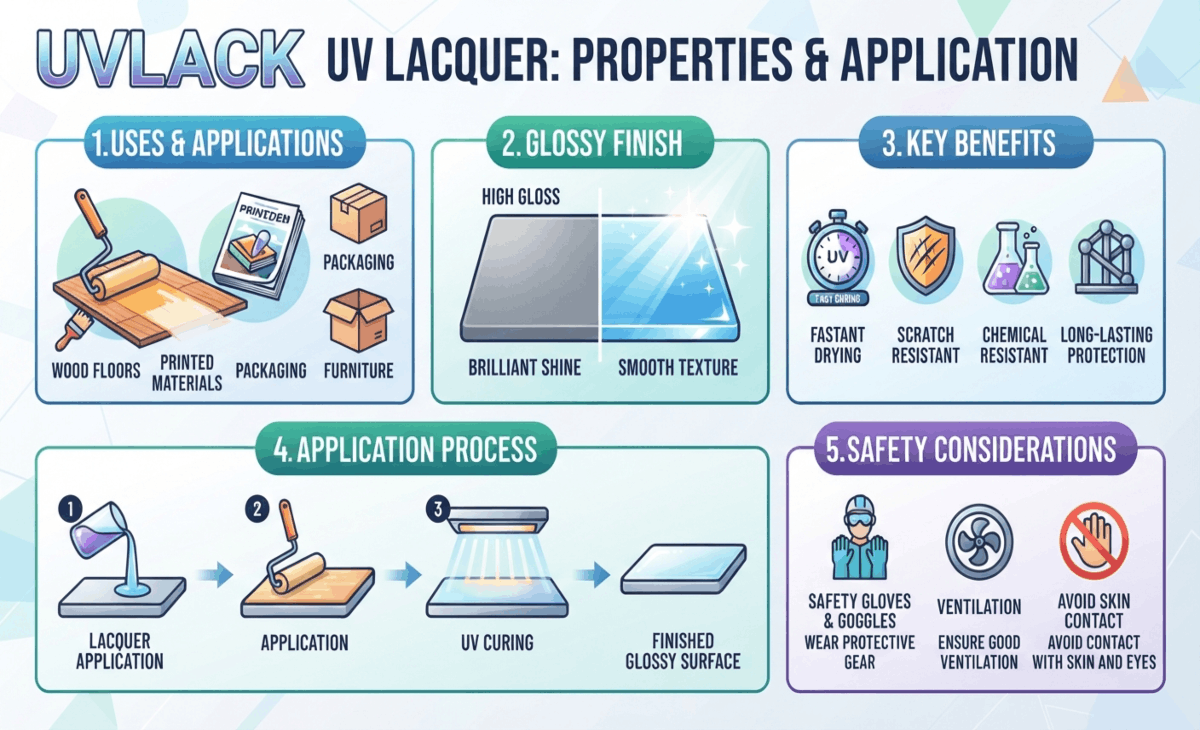
Uvlack is a term commonly associated with UV lacquer or UV varnish. It refers to a coating used mainly in printing and packaging, where ultraviolet light helps the liquid coating become hard in a very short time.
There are several different explanations of Uvlack online. Some connect the term with UV varnish products, while other pages use it for unrelated technologies or names. This guide focuses on the connection between Uvlack and UV lacquer, including how the coating works, where it is used, and what to consider before choosing it.
What Is Uvlack?
Uvlack is associated with UV lacquer, which is also called UV varnish or UV coating. It is a liquid coating that becomes hard when exposed to ultraviolet light.
In printing, the coating is generally applied over an already printed surface. It can provide a protective layer while also changing the appearance and feel of the finished material.
UV coating and UV curing are established technologies used in different industries. However, Uvlack itself is not a universally standardized term. Some information also uses UVLACK as the name of particular UV varnish products.
The word is often explained as a combination of “UV,” referring to ultraviolet light, and “lack,” a term connected with lacquer or varnish in German and some other European languages.
There are also unrelated descriptions of Uvlack online, including references to software, digital platforms, and other technologies. The available information does not clearly establish these as standard meanings.
For that reason, Uvlack is best understood in the context of UV lacquer and UV coating while recognizing that the exact term can vary depending on the source.
How Does UV Curing Work?
UV lacquer does not harden in the same way as ordinary paint or varnish. Instead, it goes through a process called UV curing.
The liquid coating is first applied to the surface. Depending on the production method, rollers, screens, or other coating equipment may be used.
The coated material then passes beneath a UV light source. UV lacquer contains substances known as photoinitiators. When ultraviolet light activates these substances, a chemical reaction begins and the liquid coating rapidly becomes a solid layer.
The process can be summarized as follows:
- Liquid UV lacquer is applied to the material.
- The coated material moves through the curing system.
- UV light activates the photoinitiators.
- A chemical reaction hardens the coating.
- The finished material continues to the next production stage.
With suitable equipment and coating conditions, curing can happen extremely quickly. Some industrial UV coatings can harden in less than a second.
This speed is particularly useful in commercial printing because products may be ready for cutting, folding, binding, or packaging soon after coating.
What Is UV Lacquer Made Of?
The precise formula depends on the manufacturer and the intended application. However, UV coatings commonly contain oligomers, monomers, photoinitiators, and other additives.
Oligomers and monomers help form the structure of the finished coating. Their formulation can influence characteristics such as hardness, flexibility, durability, and surface appearance.
Photoinitiators are important because they respond to ultraviolet light and initiate the chemical reaction that turns the liquid coating into a solid layer.
Additional ingredients may be included to change the performance or appearance. Some additives can reduce gloss, while others may improve resistance to scratches, rubbing, or other forms of handling.
Not all UV lacquers have identical formulas. Manufacturers can adjust their compositions according to the substrate, coating equipment, curing system, and finish required.
Types of UV Lacquer Finishes
UV lacquer can produce several different finishes. The appropriate choice depends on the appearance and tactile effect required.
Gloss UV
Gloss UV produces a shiny surface and can make printed colors appear more vivid.
It is commonly used for packaging, labels, promotional products, and other printed materials where a noticeable shine is desirable.
Matte UV
Matte UV creates a lower-shine surface with less reflection than a gloss finish.
It can provide a softer appearance and is often used on book covers, packaging, cards, and other printed products where a highly reflective surface is not preferred.
Spot UV
Spot UV is applied only to selected parts of a design rather than the entire surface.
A printer might use spot UV on a logo, headline, photograph, or decorative pattern while leaving the surrounding area untreated.
The contrast between coated and uncoated sections can make particular design elements more noticeable. Spot UV is frequently used on business cards, packaging, covers, and promotional materials.
Raised and Textured UV
Some UV coating systems can create raised or textured effects.
A thicker layer can make a logo, word, or pattern stand above the surrounding surface. Depending on the application, the effect may also be noticeable when the finished material is touched.
The final result depends on factors such as coating thickness, formulation, equipment, and curing conditions.
Spot UV vs Full UV Coating
The main difference between spot UV and full UV coating is how much of the surface receives the finish.
Spot UV covers selected sections. For example, a business card might have UV coating only on its logo.
Full UV coating covers most or all of the surface, giving the entire product a consistent finish. It can be used to create an overall gloss or matte appearance while adding a degree of surface protection.
Spot UV is useful when the goal is to draw attention to specific design elements. Full UV coating is more appropriate when the entire surface needs the same finishing treatment.
Where Is Uvlack Used?
UV lacquer is widely associated with printing and packaging applications.
It can be used on business cards, brochures, flyers, folders, postcards, book covers, labels, posters, product boxes, and other printed materials.
Packaging is an especially common application. A company might use full UV coating across a box or apply spot UV only to its logo, product name, or selected artwork.
UV-curable coatings can also be formulated for substrates other than paper. Depending on the specific product, these may include plastic, wood, metal, furniture components, flooring, and certain automotive or electronic parts.
These broader applications are uses of UV coatings generally and do not necessarily mean that every product described as Uvlack is suitable for them.
Compatibility with the material is important. A UV lacquer designed for paper may not perform correctly on plastic or metal. Testing is often necessary before a large production run.
Benefits of UV Lacquer
One of the main advantages of UV lacquer is its rapid curing speed. Under suitable conditions, the coating can become hard very quickly.
This can help printing operations save production time. Finished materials can move into cutting, folding, binding, or packaging without waiting through a lengthy conventional drying period.
UV lacquer can also improve resistance to scratches, rubbing, and ordinary handling, depending on the formulation.
Appearance is another major benefit. Gloss UV can add shine, matte UV can reduce reflection, and spot or raised UV can make selected parts of a design stand out.
Some UV coatings can also provide resistance to light moisture. However, UV coating should not automatically be considered waterproof because performance depends on the particular product and application.
Compared with some solvent-based coatings, certain UV systems may also produce fewer volatile organic compound (VOC) emissions because much of the coating becomes part of the cured solid layer.
You May Also like this: UploadArticle.com Guide: How It Works, Publishing, SEO, Backlinks, and Benefits
Limitations of UV Lacquer
UV lacquer is not the best choice for every project.
Specialized equipment is required to apply and cure the coating. As a result, not every printing operation can provide UV finishing.
The coating must also be compatible with the material being coated. Different papers, plastics, inks, woods, and metals can require different formulations.
Some UV coatings may crack when the finished material is heavily folded or bent. This makes testing particularly useful for packaging, cards, and other products that will undergo significant movement.
Cost can also be higher than producing a printed product without a special finish.
Spot UV requires accurate registration with the underlying design. If the coating does not align correctly with the logo, text, or image, the final result may look uneven.
UV lacquer also does not necessarily offer the same level of physical protection as lamination. When strong protection against handling, moisture, or abrasion is the priority, lamination may be a better choice.
UV Lacquer vs Other Print Finishes
UV lacquer is one of several finishing methods available for printed materials.
| Finish | How It Works | Main Benefit | Main Limitation |
| UV lacquer | Hardens under UV light | Fast curing and multiple visual effects | Requires UV equipment |
| Aqueous coating | Water-based coating dries with air and heat | General surface protection | Different finish and durability |
| Traditional varnish | Dries through conventional drying processes | Straightforward print finishing | Usually slower |
| Solvent-based coating | Solvent evaporates as the coating dries | Useful for certain specialized applications | Can release more VOCs |
| Lamination | Plastic film is applied to the surface | Strong physical protection | Adds another material and production step |
It can be especially useful when fast curing, visual impact, or selective finishing is important.
Lamination is often preferred when the finished product needs stronger physical protection.
The best choice depends on the material, budget, design, production method, and level of durability required.
UV Coating vs UV Printing
UV printing uses specially formulated ink that is cured with UV light shortly after being printed. The UV light hardens the ink and helps it remain on the surface.
UV coating adds a separate coating layer over a printed or manufactured surface. Its purpose can be protection, appearance, or both.
For example, a product package could first be printed using UV-curable ink. A clear spot UV coating could then be applied over its logo to create a highlighted effect.
The distinction is simple: printing creates the design, while coating provides an additional finishing layer.
Equipment Needed for UV Coating
UV coating requires equipment capable of applying the liquid material and exposing it to the correct UV light.
Depending on the production system, the coating can be applied with rollers, screens, flexographic units, or specialized coating machines.
The curing stage may use traditional UV lamps or newer UV-LED systems.
The coating formulation must be compatible with the light source and curing conditions being used.
UV coating can be performed inline, as part of the main printing or manufacturing process, or offline, using a separate coating machine after printing.
The quality of the finished result can depend on several factors, including coating thickness, UV intensity, machine speed, ink, substrate, and surface condition.
UV-LED curing systems can produce less heat and may consume less energy in some production environments compared with certain traditional UV lamp systems.
Is Uvlack Safe?
The safety of UV lacquer depends on the specific formulation and whether the coating is uncured or fully cured.
Liquid UV coating is an industrial chemical product, so workers should follow the manufacturer’s handling and safety instructions.
Depending on the product and application, protective equipment and adequate ventilation may be necessary. UV curing equipment should also be properly shielded because direct exposure to strong UV radiation can be harmful.
After the coating has been properly cured, it forms a solid finished layer intended for its specified application.
That does not mean every UV coating is automatically suitable for every use.
Food packaging requires particular attention. A UV coating should only be used for food-related applications when the specific product and production process meet the applicable requirements.
Environmental Considerations
UV coatings can offer certain environmental advantages compared with some solvent-based coating systems.
Because much of the coating becomes part of the cured solid layer, less material may need to evaporate during the curing process. Depending on the formulation, this can result in lower VOC emissions than some traditional solvent-based alternatives.
Rapid curing can also reduce the need for extended drying periods.
UV-LED curing systems may use less energy and produce less heat than some conventional UV lamps.
However, UV coating should not automatically be described as environmentally friendly. Its overall impact depends on factors such as ingredients, energy consumption, waste, substrate, recycling considerations, and the wider manufacturing process.
How to Choose the Right UV Finish
Begin with the effect you want to achieve.
If the entire product should have a shiny appearance, full gloss UV may be appropriate. If the goal is to emphasize a logo, photograph, headline, or pattern, spot UV may be more suitable.
The substrate is equally important. Confirm that the selected coating is designed to work with the paper, plastic, ink, wood, metal, or other material being used.
Consider what happens after coating as well. Folding, cutting, binding, gluing, and other finishing processes can affect the choice of coating.
For a large production job, testing a small sample can be useful. Check the finish for appearance, adhesion, curing, and resistance to rubbing.
For spot UV, make sure the coating registers accurately with the printed design.
Physical samples can be particularly helpful when comparing gloss, matte, raised, and textured finishes because the appearance and feel may not be fully represented on a screen.
Cost should also be considered. Premium UV finishes can make sense for packaging, business cards, covers, and marketing products where presentation matters. Basic printed materials may not need an additional UV finish.
Why Is There Conflicting Information About Uvlack?
The term Uvlack appears with different meanings across online sources.
Some information connects it directly with UV lacquer and UV coating. Other pages use the name in connection with software, digital platforms, health-related technology, or possible brand names.
These descriptions are not interchangeable.
What is well established is that UV curing, UV coating, UV lacquer, and UV varnish are real technologies used in industrial applications.
The exact term Uvlack is less consistent. It should therefore not automatically be treated as the universal name for every UV coating.
Some information also connects UVLACK with specific UV varnish product names, including standard and spot varnish products.
Context is therefore important. If Uvlack refers to a particular commercial product, the manufacturer’s technical documentation is the better source for information about its ingredients, supported materials, curing requirements, and intended applications.
For general research, terms such as UV coating, UV lacquer, UV varnish, and UV curing provide a clearer description of the underlying technology.
Bottom Line
Uvlack is mainly associated with UV lacquer or UV varnish, a type of coating that becomes hard quickly when exposed to ultraviolet light.
UV coatings are widely used in printing and packaging. They can add gloss, produce matte effects, highlight selected design elements, create raised or textured finishes, and provide additional surface protection.
At the same time, UV lacquer requires suitable equipment, compatible materials, and the correct curing conditions.
The term Uvlack itself is not used consistently across all sources. Because of that, unrelated meanings should be treated carefully, and specific products should be checked against reliable manufacturer information and technical documentation.
Frequently Asked Questions
What does Uvlack mean?
Uvlack is a term associated with UV lacquer or UV varnish. It generally refers to a coating that hardens when exposed to ultraviolet light.
Is Uvlack the same as UV lacquer?
Uvlack is linked to UV lacquer, but it is not necessarily a universal standard name for every UV lacquer product.
How does UV lacquer cure?
UV light activates photoinitiators in the coating. This starts a chemical reaction that rapidly turns the liquid coating into a solid layer.
How quickly does UV lacquer cure?
With suitable equipment and conditions, some UV lacquers can cure in less than a second, while curing time varies by product and production setup.
What is spot UV?
Spot UV is a UV coating applied only to selected areas of a design, such as a logo, image, headline, or pattern.
Can UV coating be used on materials other than paper?
Yes. Some UV coatings are formulated for materials such as plastic, wood, and metal, although compatibility depends on the specific coating and surface.
Is UV lacquer safe?
Properly cured UV lacquer forms a solid layer intended for its specified use. However, uncured coating and UV curing equipment require appropriate safety procedures.
Is UV coating better than lamination?
Neither is automatically better. UV coating can provide visual effects and a protective finish, while lamination generally offers stronger physical protection. The better option depends on the product and its intended use.
