


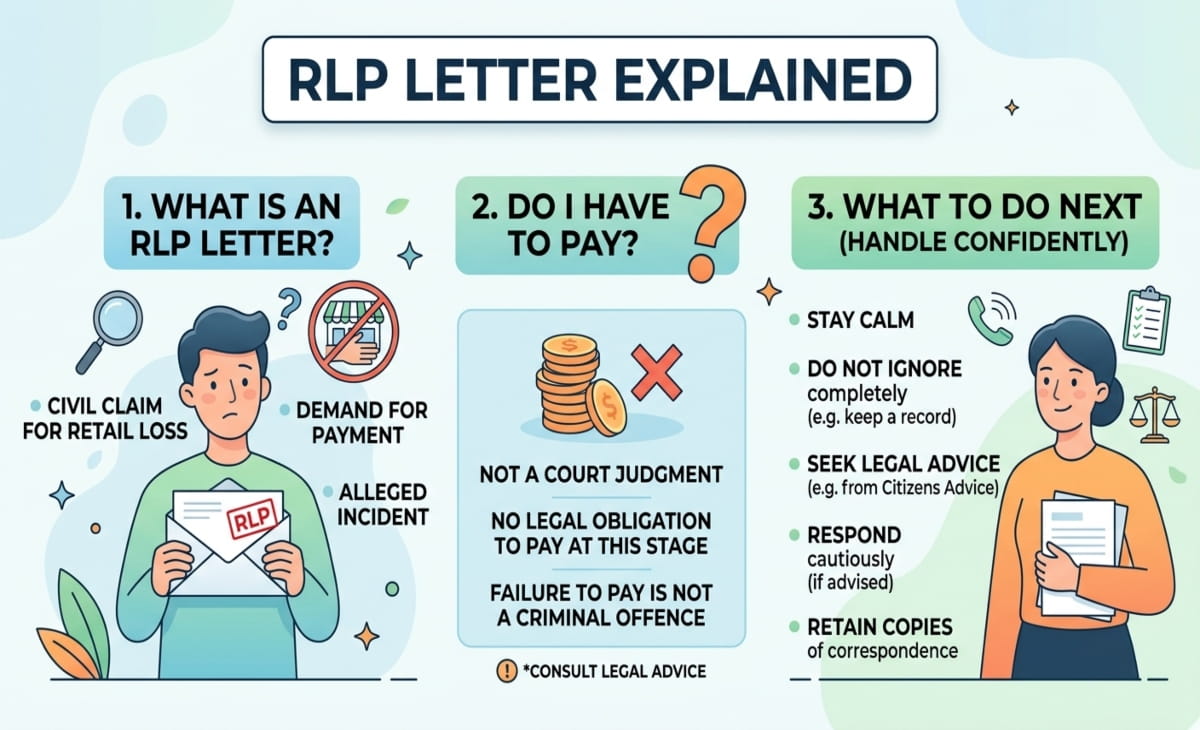
Receiving an RLP letter can be stressful, particularly if you have never heard of Retail Loss Prevention Ltd before. Many people receive these letters following an alleged shoplifting incident and immediately worry about whether they must pay, whether the letter is legally binding, or whether it could affect their criminal record.
An RLP letter is generally a civil recovery demand sent by Retail Loss Prevention Ltd on behalf of a retailer. It requests payment for losses the retailer claims resulted from an incident involving alleged theft or shoplifting.
This guide explains what an RLP letter is, why people receive one, how the payment demands work, and what options may be available under UK law. It also covers potential consequences, common misunderstandings, and practical steps to consider before responding.
What Is an RLP Letter?
An RLP letter is a civil recovery demand sent by Retail Loss Prevention Ltd (RLP) on behalf of a retailer. It usually follows an alleged shoplifting or retail theft incident and asks the recipient to pay compensation for losses the retailer says it has experienced.
The letter relates to a civil claim rather than being a criminal penalty. Its purpose is to seek financial recovery for the retailer, not to impose a criminal sentence. Even if the underlying incident involves an allegation of theft, the RLP letter is separate from any police investigation or criminal court proceedings.
A common misunderstanding is that receiving an RLP letter means someone has already been found guilty of an offence. That is not what the letter itself establishes. It is a demand for payment, not a criminal conviction, court judgment, or automatic finding of legal responsibility.
Most letters identify the retailer involved, provide details of the alleged incident, state the amount being requested, and give a deadline for responding or paying. Some also explain that the retailer may consider court action if the claim remains unresolved.
It is important to read the letter carefully and understand what is being claimed before deciding how to respond.
What Is Retail Loss Prevention Ltd (RLP)?
Retail Loss Prevention Ltd, commonly known as RLP, is a private company in the United Kingdom that provides civil recovery services for retailers.
Retailers may use these services when they believe they have experienced financial losses because of shoplifting, employee theft, or similar incidents. Rather than managing every recovery request themselves, they may ask RLP to contact the person involved and request payment.
RLP is not a government department, police force, or court. It cannot independently arrest someone, issue criminal fines, or determine whether a person is guilty of an offence. Its role in this context is to manage civil recovery claims on behalf of retailers.
Various retailers have been reported to use RLP or similar civil recovery services. Public reports have mentioned businesses such as Boots, Tesco, TK Maxx, B&Q, Superdrug, and Wilkinson in connection with these practices.
However, the appearance of a retailer’s name on a letter does not by itself establish that the amount claimed is legally owed. The details of the individual case and the legal basis for the claim remain important.
Why Do People Receive an RLP Letter?
An RLP letter is generally sent when a retailer believes that a person was involved in shoplifting or another incident that caused a financial loss.
Common situations include:
- Alleged shoplifting from a retail store.
- Alleged theft by an employee.
- An incident in which store security detained someone.
- A situation in which goods were recovered before the person left the store.
Some recipients are surprised to receive a letter even though the goods were returned immediately, no prosecution followed, or no criminal charges were brought.
This can happen because a civil recovery claim is separate from criminal proceedings. A retailer may attempt to recover certain losses through a civil process even if there has been no criminal conviction.
However, receiving the letter does not automatically mean that the recipient is legally responsible for the amount requested. If a retailer pursues a claim through the courts, it would generally need to establish that the claim has a valid legal basis and that the amount sought is recoverable.
The circumstances of the incident, the evidence available, and the nature of the claimed losses can all matter.
What Does an RLP Letter Usually Include?
Although the wording can differ between letters, most RLP demands contain several common details.
They may include:
- The name of the retailer making the claim.
- The date and location of the alleged incident.
- A case reference number.
- The amount being requested.
- A payment or response deadline, often around 21 days.
- Details of a possible early settlement amount.
- A statement that the retailer may consider court action if payment is not made.
The amount requested is often a fixed sum rather than a calculation based solely on the retail price of the goods involved. Historically, civil recovery demands of this type have commonly been reported in the range of approximately £87.50 to £250, depending on the circumstances described.
These historical figures should not be treated as a guaranteed current tariff or proof that a particular demand is reasonable.
An RLP letter is intended to explain the retailer’s claim. It does not have the same legal effect as a court judgment, an official criminal penalty, or a police notice.
Before responding, check the information in the letter and keep a copy for your records.
Do You Have to Pay an RLP Letter?
This is often the biggest concern for someone who receives an RLP letter.
Receiving an RLP letter does not automatically mean that you have a legally enforceable obligation to pay the amount requested. The letter is a civil demand from a private company acting on behalf of a retailer, not a court order.
If the retailer wants to recover money through the courts, it would generally need to prove its claim. In a civil case, the court considers the evidence and determines whether the claimant has established a legal entitlement to the amount being sought.
The retailer may need to demonstrate that a loss occurred, that the recipient is legally responsible for it, and that the amount claimed is recoverable under the relevant law.
Until a court makes a judgment, the amount in the letter remains a claim rather than a debt established by that judgment. This does not mean that every demand is invalid or that a recipient can safely ignore all correspondence.
Some people choose to pay because they want to settle the matter quickly. Others dispute the claim or obtain independent advice before deciding what to do.
The most appropriate response depends on the circumstances, the evidence, and the legal basis of the demand. If you are unsure about your position, consider seeking independent advice before paying or admitting liability.
How Are RLP Compensation Amounts Calculated?
RLP letters often request a fixed amount rather than simply asking for the retail value of the goods involved.
Historically, reported civil recovery demands have commonly ranged from around £87.50 to £250, with the requested amount varying according to the circumstances and the retailer’s claim.
The amount may include costs that the retailer says arose from the incident, such as administration or security expenses. However, the fact that a retailer lists a cost in its demand does not automatically establish that the cost is legally recoverable from the recipient.
If a civil recovery claim reaches court, the claimant would generally need to establish the legal basis for the amount sought. The court would consider the evidence and the applicable legal principles rather than automatically treating a fixed demand as payable.
This issue has attracted criticism from some legal commentators and consumer advice organizations, particularly when the requested amount appears substantially higher than the value of the goods involved.
The important distinction is between the amount a company asks for and the amount it could establish that it is legally entitled to recover.
What Are Your Options After Receiving an RLP Letter?
If you receive an RLP letter, there are several possible ways to respond. The appropriate option depends on the facts of your case and whether you believe the claim is justified.
Ignore the Letter
Some people choose not to respond to an RLP letter.
Ignoring it does not automatically result in arrest, a criminal conviction, or court proceedings. However, you may receive further letters requesting payment, and the retailer may decide to pursue a civil claim.
Although smaller claims may not always proceed to court, you should not assume that court action is impossible. Read the letter carefully, keep all correspondence, and consider getting advice before deciding not to respond.
A letter from RLP should also be distinguished from formal court documents. If you receive actual court papers, do not ignore them; follow the instructions and deadlines stated in those documents.
Deny Liability
If you believe you are not legally responsible for the claim, you can consider writing to RLP to state that you deny liability.
Keep your response clear, factual, and focused on the matters being disputed. Explain the relevant reasons without including unnecessary personal information or making statements you do not intend to make.
Keep a copy of any letter or email you send, along with evidence of delivery where available.
If the circumstances are complicated or the allegation could have wider consequences, independent legal advice may help you understand how to respond appropriately.
Make a Reduced Settlement Offer
Some recipients consider offering a lower amount to settle a civil recovery claim.
This may be an option for someone who wants to resolve a dispute without agreeing to the full amount requested. However, making an offer can have legal implications depending on the wording and circumstances.
In some situations, people may make a separate settlement proposal marked “Without Prejudice.” The effect of that wording depends on the circumstances, so it should not be treated as a guaranteed way to protect every communication.
Consider obtaining independent advice before making an offer, particularly if you dispute liability or are unsure whether the amount requested is legally recoverable.
Pay the Amount Requested
Some recipients decide to pay the full amount stated in the letter.
Payment may resolve the civil recovery claim, depending on the terms of the settlement and whether the payment is accepted as full and final settlement. Before paying, make sure you understand what the payment covers and whether the matter will be considered closed.
It is sensible to obtain written confirmation of any settlement terms and retain proof of payment.
Do not assume that paying is the only available option simply because the letter contains a deadline. Equally, do not assume that a demand can never lead to a valid civil claim.
Consider Getting Independent Advice
If you are uncertain about the letter or the best response, independent advice can help you understand your options.
Citizens Advice provides information about consumer and civil matters. A qualified solicitor can also explain how the law may apply to the facts of your particular case.
Advice can be especially valuable if you are a minor, the allegation is disputed, the amount is significant, or you have received formal court documents.
Can an RLP Letter Affect Your Criminal Record or Credit Score?
An RLP letter does not, by itself, create a criminal record. It is a civil recovery demand, not a criminal conviction.
Where no criminal proceedings or conviction arise, receiving the letter alone does not amount to a criminal record entry. It is also not, by itself, a criminal penalty or a court finding of guilt.
In most cases, the letter itself does not directly affect your credit score.
However, the position may change if the retailer brings a civil claim and obtains a County Court Judgment (CCJ). An unpaid judgment may affect your credit history, subject to the applicable rules and circumstances.
A CCJ is different from an RLP demand letter. The letter is a request for payment, while a judgment is a court decision that can have legal consequences.
If you receive formal court papers following an RLP demand, take them seriously and seek advice about the relevant response deadline.
What Have Citizens Advice and Parliament Said?
Civil recovery letters have attracted public discussion and criticism over the years.
Citizens Advice has raised concerns about the fairness of some civil recovery demands, particularly where the requested payment is considerably higher than the value of the goods involved. Concerns have also been expressed about the pressure recipients may feel when a letter mentions possible court action.
Parliamentary discussions have addressed civil recovery practices as well. Some Members of Parliament have raised questions about the impact of these letters on young people, vulnerable individuals, and people who may not understand the difference between a civil demand and a criminal matter.
These discussions do not establish that every RLP letter is invalid. They demonstrate that civil recovery practices have received public attention and that the fairness and legal basis of individual demands can be important issues.
If you are concerned about a particular demand, focus on the facts of your case and seek reliable, independent guidance rather than relying solely on general statements about RLP.
Common Myths About RLP Letters
There are several common misunderstandings about what an RLP letter means and what may happen after receiving one.
It Is a Police Fine
No. An RLP letter is a civil recovery demand from a private company acting on behalf of a retailer. It is not a police fine or a criminal penalty issued by a government authority.
Ignoring It Will Lead to Arrest
Receiving or ignoring an RLP demand does not automatically lead to arrest. RLP cannot independently arrest someone or order the police to arrest a person simply because a payment has not been made.
However, a retailer may consider civil court proceedings, and any formal court documents should be handled according to their instructions.
You Must Pay Immediately
Not simply because the letter requests payment. An RLP letter is a demand rather than a court order, and the recipient may have grounds to question the claim.
Whether payment becomes legally enforceable depends on the circumstances and, if the matter proceeds to court, the outcome of the proceedings.
Paying Removes a Criminal Record
No. Paying a civil recovery demand does not remove a criminal record. The demand itself does not create a criminal conviction in the first place.
Civil settlement and criminal proceedings are separate matters.
Goods Were Returned, So There Can Be No Claim
Not necessarily. A retailer may still attempt to recover certain losses through a civil claim even if goods were recovered or returned.
However, the retailer would still need a valid legal basis for any amount it seeks to recover. Whether a claim is justified depends on the facts, evidence, and applicable law.
Tips If You Receive an RLP Letter
If an RLP letter arrives, taking a careful and organized approach can help you avoid unnecessary stress.
- Read the letter carefully. Identify the retailer, the alleged incident, the amount requested, and the stated deadline.
- Do not panic. A demand letter is not the same as a court judgment or criminal conviction.
- Keep records. Save the original letter and copies of any emails or responses.
- Check the claim. Consider whether the details match your understanding of the incident and whether you dispute any part of the demand.
- Seek independent advice. Citizens Advice or a qualified solicitor may help you understand your options.
- Avoid rushed decisions. Make sure you understand the potential consequences before paying, admitting liability, or making a settlement offer.
- Take court documents seriously. If the matter progresses to formal proceedings, follow the relevant instructions and deadlines.
These steps can help you make a more informed decision about how to handle the letter.
Bottom Line
An RLP letter is a civil recovery demand sent by Retail Loss Prevention Ltd on behalf of a retailer following an alleged shoplifting, theft, or similar incident. It is not a police fine, criminal charge, or court order.
Receiving the letter does not automatically mean you must pay the amount requested. If a retailer pursues a civil claim, it would generally need to establish that it has a valid legal entitlement to recover the money.
If you receive an RLP letter, read it carefully, keep all relevant records, and consider your options before responding. Independent advice can be useful if you dispute the claim or are uncertain about your rights.
Understanding the difference between a civil demand, a criminal allegation, and a court judgment can help you approach the situation more calmly and make a decision based on your individual circumstances.
Frequently Asked Questions
What is an RLP letter?
An RLP letter is a civil recovery demand sent by Retail Loss Prevention Ltd on behalf of a retailer following an alleged shoplifting or theft incident. It requests payment for alleged losses but is not, by itself, a criminal penalty or court judgment.
Do I legally have to pay an RLP letter?
Not automatically. The letter is a payment demand rather than a court order. Whether the amount is legally recoverable depends on the circumstances and the legal basis of the claim. If the matter reaches court, the court considers the evidence before making a decision.
What happens if I ignore an RLP letter?
You may receive further payment requests, and the retailer may consider civil court action. Ignoring the letter does not automatically result in arrest or a criminal record, but you should not assume that court proceedings are impossible.
Can an unpaid RLP letter affect my credit score?
The letter itself does not normally affect your credit score. However, if the retailer obtains a County Court Judgment and it remains unpaid, the judgment may affect your credit history under the applicable rules.
What should I do if I receive an RLP letter as a minor?
If you are under 18, speak with a parent, guardian, or trusted adult and consider seeking advice from Citizens Advice or a solicitor before responding or making a payment. Do not assume that the same considerations apply to minors and adults in every situation.
