


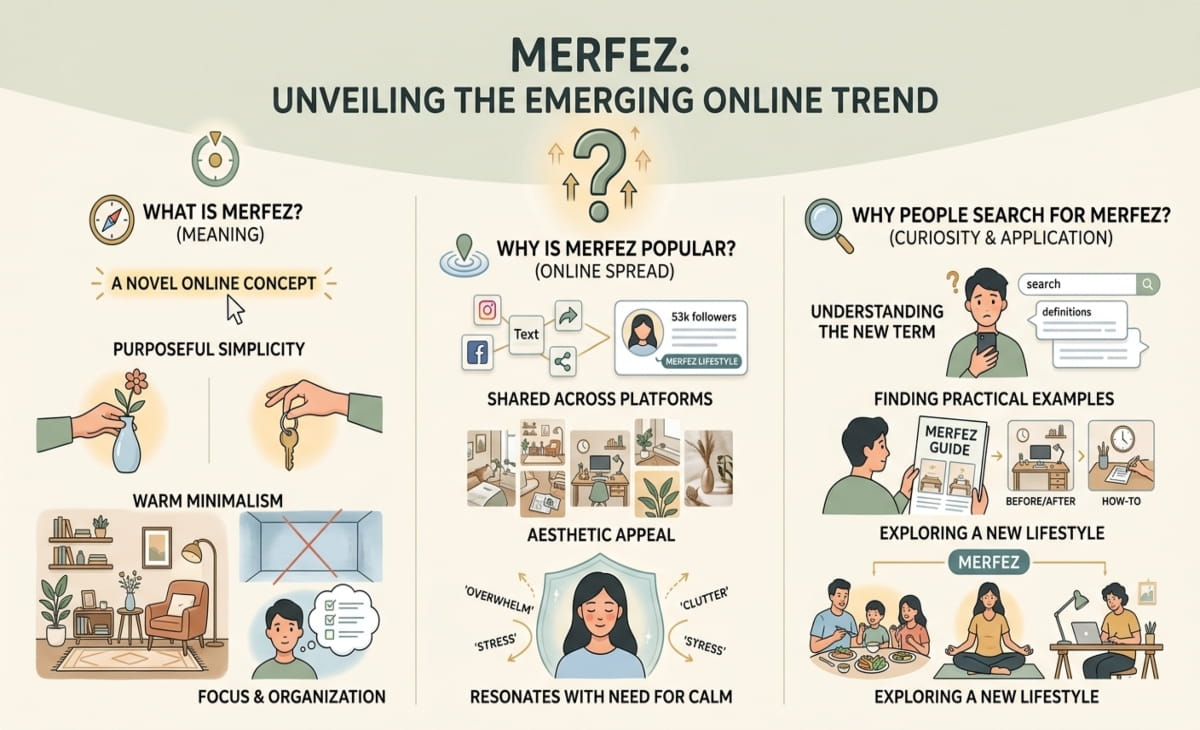
The internet can turn an unfamiliar word into a topic of interest in a surprisingly short time. A term may begin with very little public recognition, then appear in blog posts, search results, social media discussions, and online guides. Merfez is an example of this kind of curiosity. The word is short, unusual, and not immediately clear to most readers. Naturally, people want to know what it means and why it is appearing online.
Merfez reflects an interesting part of modern digital culture. It does not appear to have one widely established public meaning. Online explanations describe it in different ways, including as a developing internet term, a flexible name, or a keyword whose meaning depends on the context in which it is used. It is not a commonly recognized English dictionary word with a single, well-established definition. This uncertainty makes merfez an interesting example of how attention can grow around a word before its meaning becomes clear.
What Is Merfez?
Merfez is best approached as an unfamiliar term that has attracted online attention. Depending on the website or discussion, it may be presented as a name, a creative concept, a blog topic, or a keyword connected with digital identity. Some online explanations associate it with subjects such as lifestyle, design, technology, and travel, while others discuss it more generally as an emerging term. However, these different uses do not establish one universally accepted meaning.
The most careful explanation is that merfez is a term people are trying to understand. It is not widely recognized in everyday English in the same way as words such as “technology,” “business,” or “fitness.” Nor is there enough clear, reliable evidence to confidently identify it as one specific company, product, place, or established movement. Readers should therefore distinguish between possible interpretations and confirmed information. A word can attract online interest without having a clearly documented history or definition.
Why Small Words Get Big Online
Short and unfamiliar words can gain attention because they are easy to remember, type, and include in online content. A term such as merfez can be used in article titles covering its meaning, possible origin, branding potential, digital culture, or search popularity. This flexibility gives content creators several ways to discuss the same keyword.
Curiosity also plays an important role. When people encounter an unfamiliar word, they often search for an explanation. Even a modest number of searches can encourage writers to publish articles that answer the question. If those articles appear in search results, more readers may encounter the term and search for it themselves. This process can gradually increase its visibility.
Another factor is competition. Established keywords often have many detailed pages from trusted websites, making it difficult for new articles to rank. An unusual term may have fewer well-developed results, giving smaller publishers an opportunity to attract visitors. This can make unfamiliar keywords appealing to SEO writers, although low competition alone does not prove that a term is widely popular or important.
The Role of SEO in the Rise of Merfez
SEO, or search engine optimization, involves improving online content so that search engines and readers can understand it more easily. When an unfamiliar word begins attracting searches, publishers may create explanatory articles, definition pages, and guides to answer common questions. Merfez fits the type of keyword that can inspire this approach.
People may search for phrases such as “what is merfez,” “merfez meaning,” or “why is merfez trending.” Each query gives publishers an opportunity to provide useful information. When multiple websites publish articles around the same term, it can begin to appear more prominent across search results. However, the number of articles does not necessarily demonstrate that the word has a large audience or a recognized meaning.
Effective SEO should focus on usefulness rather than simply repeating a keyword. Search engines encourage content that helps people, demonstrates reliability, and provides an appropriate level of detail. For a topic like merfez, this means explaining what is known, identifying what remains uncertain, and avoiding invented origins or unsupported claims. Honest explanations can serve readers better than confident but unverified statements.
How Blogs Help New Words Spread
Blogs can influence how unfamiliar words are understood online. A writer may take a term with little established meaning and create an article exploring its possible uses, online visibility, or cultural relevance. That article gives readers a starting point and may encourage further discussion.
This process can develop into a cycle. One website publishes an explanation of merfez, another publisher notices the keyword and creates a separate article, and additional sites follow with their own interpretations. Over time, search results may contain several pages discussing the same word. Readers might then assume that merfez represents a major trend, even when the available evidence does not establish how widespread the interest really is.
Blogging is not inherently a problem. Well-researched articles can introduce useful ideas, clarify unfamiliar concepts, and make complicated subjects easier to understand. The difficulty arises when publishers repeat claims without checking them. An early guess about a word’s origin or purpose can be copied across several websites until it appears established. Responsible writers should evaluate claims independently instead of treating repetition as proof.
Why Unclear Terms Attract Many Articles
Unclear terms offer writers several possible angles. When a word has no widely accepted definition, different publishers can explore different interpretations. One article might consider merfez as a possible brand name, another might examine its use as an online keyword, and a third might discuss the broader relationship between unfamiliar words and digital culture.
This flexibility can make a topic easy to approach from multiple directions. However, it can also create confusion. Readers may visit several websites and find conflicting explanations, each presented as though it were definitive. Without reliable evidence, it becomes difficult to determine which interpretation, if any, reflects an established meaning.
Careful language helps prevent this problem. Writers can use phrases such as “may refer to,” “appears in some online discussions,” “is described by certain websites as,” or “does not have a clearly established definition.” These expressions communicate uncertainty without pretending that no possible interpretation exists. They also help readers separate documented facts from opinions and speculation.
Merfez and Digital Culture
Digital culture changes quickly. New expressions, usernames, brand ideas, memes, and online trends can attract attention before people fully understand their origins. Merfez illustrates how an unfamiliar term can become a subject of discussion simply because people encounter it and want an explanation.
A word does not always need a long history to become useful online. Sometimes, a short and distinctive name is enough to attract interest. Merfez may sound like a modern brand name or a coined expression to some readers, but that impression alone does not establish its origin or intended meaning. Its appearance and unfamiliarity can encourage people to investigate it further.
Many internet terms follow a similar path. They appear in limited online spaces, attract a few searches, and then become subjects of explanatory articles or social media posts. Some eventually develop recognizable meanings, while others remain niche or ambiguous. Merfez provides an example of why online visibility and established significance should be treated as separate things.
The Personal Side of Search Curiosity
Every search begins with someone looking for information. A person may come across merfez in a headline, a website, or a social media post and wonder whether it refers to a business, a product, a place, or a new trend. They may open an article because they want a straightforward explanation.
This is an important part of the search experience. People do not search only to collect facts; they also want to resolve uncertainty and understand what they have encountered. A useful article should respect that need by offering clear explanations instead of making an unfamiliar topic seem more complicated than it is.
For example, someone researching merfez may want answers to questions such as:
- What does merfez mean?
- Is merfez a recognized word?
- Why are websites publishing articles about it?
- Is merfez connected to a verified brand or product?
- How can readers evaluate claims made about merfez?
A strong explanation should address these questions in accessible language. When an answer cannot be confirmed, the article should say so rather than fill the gap with an unsupported story.
The Risk of Fake Authority
One of the main risks associated with unfamiliar online terms is the appearance of false authority. A webpage may sound convincing while offering little evidence to support its claims. It might describe a word as ancient, culturally significant, commercially successful, or connected to a major development without identifying trustworthy sources.
Some online discussions of merfez offer broad interpretations that connect the word with several unrelated subjects. Different interpretations do not automatically mean that the information is false, but they make verification especially important. Readers should look for evidence before accepting a detailed explanation as established fact.
A more trustworthy approach is to acknowledge the limits of available information. An article can explain that merfez appears in different online contexts while making clear that its meaning is not firmly established. It can also encourage readers to compare sources and look for original documentation. Transparency helps build credibility because it allows readers to understand what is known and what remains uncertain.
Why Low-Competition Keywords Grow Fast
Low-competition keywords can attract attention from bloggers because they may offer opportunities to rank in search results. When few authoritative pages cover a particular term, a useful and well-structured article may have a better chance of becoming visible. This is one reason publishers sometimes focus on unusual or emerging keywords.
Merfez fits the general profile of a keyword that can inspire explanatory content. Writers might create pages titled “What Is Merfez?” or “Merfez Meaning Explained” to address potential search questions. Such titles make the subject clear and help readers understand what an article promises to explain.
However, low competition should never become a reason to publish weak or repetitive material. An article still needs to offer genuine value, provide relevant context, and distinguish verified information from assumptions. Publishing several pages with different wording but no additional evidence may increase the volume of content without improving readers’ understanding.
How Writers Can Cover Merfez the Right Way
Writers can explain merfez responsibly by focusing on what can be supported. They should avoid assigning the term a definite origin or meaning unless reliable evidence is available. They should also avoid presenting it as a recognized company, physical location, product, or cultural movement without credible documentation.
A useful article about merfez can take several practical steps:
- Explain that the term has no clearly established, widely accepted public meaning.
- Describe why unfamiliar words can attract searches and online attention.
- Discuss the role of SEO and blogging in spreading new keywords.
- Separate documented information from possible interpretations.
- Encourage readers to check the sources behind important claims.
- Use straightforward examples to explain how online curiosity develops.
- Avoid invented histories, exaggerated popularity claims, and unsupported conclusions.
This approach produces content that is more informative and trustworthy. It also helps readers understand the wider subject instead of leaving them with another uncertain definition.
What Readers Should Check Before Trusting Merfez Claims
Readers should evaluate strong claims about merfez before accepting them. A good starting point is to look for an official website or other primary source if the term is being presented as a company, service, or product. They should then examine whether the source provides verifiable information about its identity, purpose, history, or activities.
Comparing multiple sources can also help, provided those sources are genuinely independent. If several articles repeat the same statement without identifying its original source, the repetition does not make the statement more reliable. Readers should look for specific evidence rather than relying only on confident wording.
Vague or exaggerated language deserves additional attention. If a page claims that merfez is transforming an industry but offers no examples, supporting data, or identifiable organizations, its conclusion may be overstated. Similarly, if a supposed product has no verifiable company details, clear documentation, or reliable user information, readers should be cautious. They should avoid providing payment information or personal details to unfamiliar services until they have established that those services are legitimate.
Why Merfez Matters as a Digital Example
Merfez is useful as an example of how attention can develop across the internet. A short and unfamiliar word can become a subject of discussion through searches, blog articles, and people’s desire to understand something new. It does not necessarily need to begin as a recognized brand or established concept to attract online curiosity.
The process also reveals an important difference between popularity and evidence. People may search for a word because they are confused about it. Publishers may create content because the keyword appears to offer an opportunity. Search results may then contain more articles about the term. These developments can increase visibility, but they do not independently prove that the word has a settled definition or widespread cultural importance.
This does not make merfez irrelevant. Rather, it makes the term a useful example for understanding online language, content creation, and search behavior. It shows why readers and writers should look beyond the number of pages discussing a subject and consider the quality of the information those pages provide.
Final Thoughts
Merfez is an unusual word that has attracted online attention, but its meaning is not firmly established in common public usage. Different websites may describe it in different ways, which makes it important to approach confident explanations with care. The term also illustrates how search engines, blogs, and digital curiosity can bring unfamiliar words into wider online discussions.
The best way to understand merfez is to ask straightforward questions. What does the available evidence show? Who is making the claim? Is there a reliable source? Does the explanation help readers understand the term, or does it simply make the word sound more important than the evidence supports?
Ultimately, merfez offers a useful lesson about modern digital culture. Unfamiliar terms can attract attention quickly, but attention alone does not establish meaning or credibility. Clear writing, careful research, and transparent explanations remain essential for anyone trying to understand what they find online.
