


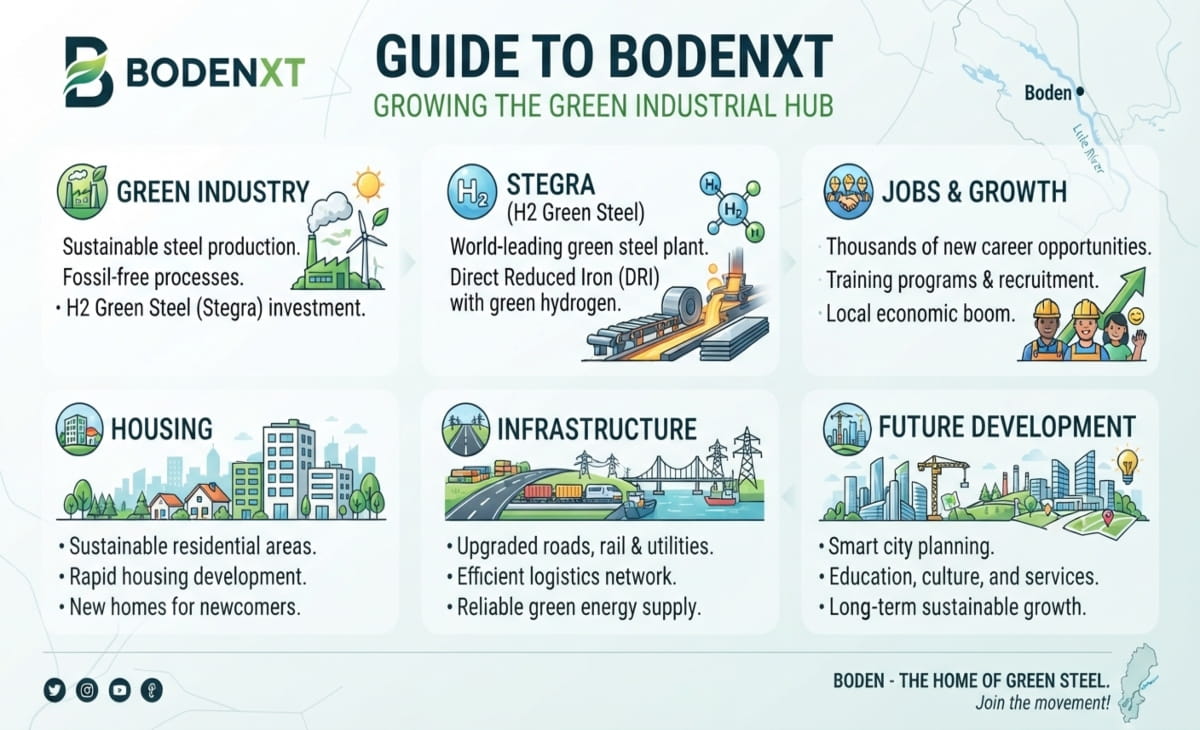
Bodenxt is a development platform connected with Boden Municipality in northern Sweden. It helps the municipality manage rapid changes as green industries bring investment, workers, businesses, and new demands to the area.
Many people search for Bodenxt because of its connection with Stegra and the growing green steel industry. However, Bodenxt covers much more than one industrial project. Its work also involves housing, employment, education, transportation, utilities, business development, and community services.
As Boden continues to grow, these areas need to develop together. This guide explains what Bodenxt is, how it relates to Stegra, why Boden is attracting industrial investment, and how the municipality is preparing for future growth.
What Is Bodenxt?
Bodenxt is a platform used by Boden Municipality to coordinate the major changes taking place across the area.
It is not a steel company, the name of Stegra’s factory, or a single construction project. Instead, it brings together different parts of the municipality’s development work.
These areas include housing, workforce skills, local businesses, roads, railways, water, wastewater, energy, and other services needed by a growing community.
The reason for this coordinated approach is the speed of Boden’s development. The municipality has described the transformation as completing roughly 20 years of development within only a few years.
A major industrial project can create jobs quickly, but those workers also need homes. New housing requires electricity, water, roads, schools, shops, and other public services. Businesses need employees, transport connections, and suitable commercial spaces.
Bodenxt helps the municipality consider these requirements together rather than treating each development issue separately.
This approach is important because industrial growth affects more than factories. It can change the population, housing market, local economy, and everyday life of an entire community.
Bodenxt and Stegra: What Is the Connection?
Bodenxt and Stegra are closely connected, but they have different roles.
Stegra, previously known as H2 Green Steel, is a private industrial company developing a large green steel plant at Boden Industrial Park. Its production plans involve hydrogen-based technology intended to reduce emissions compared with traditional steelmaking.
Bodenxt focuses on the wider development needed around this industrial investment.
For example, if Stegra requires thousands of workers directly and through its supply chain, Boden needs enough housing for them. The area also needs suitable roads, railway connections, utilities, education, healthcare, shops, and other services.
In simple terms, Stegra is developing the industrial facility, while Bodenxt helps Boden prepare the wider community for the changes associated with industrial growth.
Stegra is one of the major drivers of Boden’s transformation, but it is not the only one. Growth connected with the Swedish Armed Forces is also increasing demand for workers, homes, and local services.
This means Bodenxt has a broader purpose than supporting a single company. It helps the municipality prepare for several sources of growth and their combined effects.
Why Boden Is Growing as a Green Industry Center
Boden has several characteristics that make it suitable for large green industrial projects.
One important factor is access to fossil-free electricity. Green steel and hydrogen production require substantial amounts of electricity, making reliable energy supplies particularly important.
The area also has industrial land and transport connections. Northern Sweden has established mining and energy industries, providing access to related knowledge, workers, suppliers, and infrastructure.
These conditions have helped attract major industrial investment to the region.
However, new factories also create pressure on the town. More workers increase demand for housing, while industrial facilities need roads, railways, water, electricity, and other utilities.
Families moving to Boden also need schools, childcare, healthcare, shops, and public services.
This wider impact is one of the main reasons Bodenxt is important. The municipality needs to prepare for the community-wide effects of industrial expansion, not just the construction of new factories.
Green Steel and Hydrogen Production
Green steel is an important part of Boden’s current industrial transformation.
Traditional steel production often relies heavily on coal, which produces substantial carbon dioxide emissions. Hydrogen-based steelmaking uses a different process that can reduce the need for coal during important stages of production.
In simple terms, electricity can be used to split water into hydrogen and oxygen. The hydrogen can then be used to process iron ore instead of relying on the traditional coal-based method.
Stegra is developing this type of production in Boden. Its industrial site includes plans for large-scale hydrogen production alongside iron and steel manufacturing.
The company has stated that its process could reduce carbon dioxide emissions by up to 95% compared with steel produced using traditional coke-fired blast furnaces. This is a company-reported target, not a measured result from full commercial production.
The scale of the project also explains why its effects extend beyond the factory. A large steel and hydrogen facility requires workers, electricity, transport, suppliers, maintenance, construction, and many other services.
These requirements create business and employment opportunities while also increasing pressure on the municipality’s infrastructure and housing supply.
Bodenxt helps address the wider planning needs associated with this industrial development.
Jobs and Skills in Boden
New industrial investment is expected to create many jobs in and around Boden.
Municipal projections cited in the collected material point to approximately 10,000 direct and indirect jobs across the wider region, including roughly 2,000 jobs connected with Stegra. These figures are projections rather than confirmed permanent jobs already created.
The growing industrial economy will need many different types of workers. Opportunities are not limited to engineers.
Industrial projects require technicians, electricians, construction workers, machine operators, logistics employees, maintenance teams, managers, and other specialists.
Population growth also increases demand for teachers, healthcare professionals, retail employees, service workers, and municipal staff.
Some workers may relocate to Boden from other parts of Sweden or from other countries. However, long-term workforce development also requires local education and training.
One example is the Upper Secondary Engineering Programme at Björknäsgymnasiet, scheduled to begin in autumn 2026. The programme is intended to connect technical education with workplace learning, industrial design, and product development.
Stegra, SMS Group Nordic, local industry, and the Swedish Armed Forces have been involved in connecting the educational programme with real workplace needs.
Recruiting enough workers is only one part of the challenge. Boden must also make it possible for people to remain in the municipality.
A worker may find a suitable job but decide not to settle in Boden if housing, childcare, transport, or other essential services are unavailable. This is why workforce planning and community development are closely connected under Bodenxt.
Housing and Population Growth
Housing is one of the biggest issues associated with Boden’s rapid growth.
New jobs attract workers, but those workers need places to live. Families moving with them also require suitable homes, schools, childcare, transport, healthcare, and everyday services.
Boden ended 2025 with a reported 28,624 registered residents, exceeding the municipality’s earlier forecast. The collected sources also note that several thousand temporary workers may be living in the area without being included in the registered population.
Stegra-related relocation has already contributed to population growth. By late 2025, the municipal Relocation Service reportedly counted approximately 275 Stegra employees living in Boden. Including accompanying adults and children, the estimated number of new residents connected with the company was around 640.
However, housing supply has struggled to keep up with demand.
Current development plans have enabled approximately 1,300 apartments, according to the collected municipal figures. Despite these housing plans, the municipality reported in May 2026 that the rental vacancy rate was close to zero.
This shortage can make recruitment more difficult. Someone may accept a job in Boden but struggle to relocate permanently if suitable housing is unavailable.
The situation also affects existing residents. Young adults may find it difficult to rent their first apartment, families may have fewer options when looking for larger homes, and older residents may struggle to find smaller accommodation.
For Bodenxt, the important question is not only how many workers arrive during construction. The larger challenge is whether people choose to make Boden their permanent home.
Housing is therefore closely connected with employment, population growth, schools, transportation, and public services. Providing enough suitable homes will be essential to turning rapid industrial expansion into lasting community development.
Business Growth Beyond Stegra
Stegra is a major part of Boden’s transformation, but the wider development strategy is not limited to one company.
Large industrial projects create demand for many other businesses. Construction companies, transport firms, engineering services, maintenance providers, property companies, shops, restaurants, and technology businesses may all find new opportunities.
By June 2025, Boden reportedly had 38 new companies establish themselves in the municipality since Stegra announced its investment. This figure illustrates reported business growth around the project, although it does not mean that every new company depends directly on Stegra.
Population growth can also support local businesses. New residents need food, housing, transportation, leisure activities, repairs, professional services, and other everyday products and services.
However, business expansion also creates challenges. Companies may compete for skilled employees, commercial space, and suitable housing for their workers.
For Bodenxt, long-term business development means creating a broader local economy. A more diverse business community could help Boden become less dependent on the success of one large industrial project.
Roads, Rail, and Transport
Reliable transportation is important for industrial activity and everyday life in Boden.
One major development is the railway connection to Boden Industrial Park. The completed railway includes approximately six kilometres of track and nine bridges. It can accommodate trains up to 1,000 metres long and connects the industrial park with the wider national railway system.
The railway is important for transporting industrial materials and finished products. It can serve Stegra while also making the industrial park more accessible to other companies in the future.
Roads and local travel routes are also being developed. These connections are important for workers travelling to industrial sites and residents moving around the municipality.
Walking and cycling routes are part of the wider transport work as well. The goal is not simply to connect factories but also to make transportation practical for the wider community.
Together, these developments support industrial logistics, commuting, and everyday mobility.
Water, Power, and Other Infrastructure
Some of Bodenxt’s most important work is less visible than new factories, roads, and housing developments.
New homes and industrial facilities require reliable water supplies, wastewater systems, drainage, electricity, and digital connections. These systems need enough capacity to support a growing population and expanding industrial activity.
Planning infrastructure early is essential. A new residential area cannot function properly if the water or wastewater network lacks sufficient capacity.
The same applies to electricity. New industries may require large amounts of power, while homes, businesses, schools, and public services also need reliable supplies.
Fiber networks and other digital connections are another part of modern infrastructure. They support communication, business operations, education, and everyday services.
These infrastructure projects can be expensive and take considerable time to complete. Bodenxt therefore involves planning capacity before shortages become more serious.
By coordinating infrastructure with housing and industrial development, the municipality can prepare for growth more effectively.
Energy, Sustainability, and Resilience
Energy is closely connected with Boden’s green industrial plans.
Green steel and hydrogen production require large amounts of electricity. Access to fossil-free electricity is one reason northern Sweden has attracted investment in these industries.
However, having access to electricity is not enough. The energy system must also remain reliable as demand from industry, households, and public services increases.
Bodenxt Talks has included discussions about developing a strong energy system for northern Sweden toward 2035. These discussions have involved authorities, businesses, researchers, energy specialists, and other groups.
The conversations consider more than simply producing additional electricity. Energy systems also need to withstand disruptions and continue serving industries and communities.
For Boden, the challenge is to support three connected needs: reducing industrial emissions, providing enough electricity for growth, and maintaining a reliable energy system.
This makes energy planning an important part of the municipality’s wider development work.
Boden Plug & Play and Circular Industry
Boden Plug & Play is another part of Boden’s wider green industry plans.
According to the collected information, the area covers approximately 70 hectares and is intended for sustainable businesses and circular industrial activities.
An important concept behind this development is industrial symbiosis.
Industrial symbiosis means that a resource left over from one industrial process may be useful to another business. For example, a factory may generate excess heat that a nearby company could use instead of allowing it to go to waste.
Similar opportunities may exist for other resources and industrial by-products.
The aim is to use resources more efficiently, reduce waste, and create practical connections between companies.
This approach supports the wider goal of developing Boden as an industrial ecosystem rather than a community built around only one factory.
What Bodenxt Has Achieved So Far
Bodenxt is an ongoing transformation, so it is important to distinguish completed projects from planned developments.
One clear achievement is the new railway serving Boden Industrial Park. It has been completed and was reported as being delivered ahead of schedule and under budget.
Population changes are also visible. Boden ended 2025 with 28,624 registered residents, while hundreds of new residents have been connected with Stegra-related relocation.
Housing development has also progressed, with plans enabling approximately 1,300 apartments. However, the availability of rental housing remains a significant challenge.
Education is changing as well. New technical education is being connected more closely with the skills required by local industries.
The municipality has also used relocation support to help workers and their families settle in Boden. Relocation involves more than starting a job. People may need assistance finding housing, schools, childcare, and other essential services.
Another planned initiative is the Boden Sustainability Center. The collected information describes a budget of more than SEK 16 million and a planned period from autumn 2026 to summer 2029.
The center is intended to support cooperation between the municipality, businesses, academia, and civil society.
These developments show that Bodenxt has progressed beyond planning in several areas. However, many parts of the wider transformation are still underway.
Challenges Facing Bodenxt
Housing remains one of the clearest challenges. Very low rental availability can make it difficult for new workers and families to settle permanently in Boden.
Infrastructure is another concern. More homes and businesses require additional water, wastewater capacity, electricity, transportation, and other services.
Public services must also expand. A larger permanent population can increase demand for schools, childcare, healthcare, and municipal services.
Finding enough skilled workers is an additional challenge. Industrial companies need specialist employees, while the growing municipality also requires workers in education, healthcare, retail, construction, and other sectors.
Costs are important too. Roads, utilities, housing, schools, and other public infrastructure require substantial investment. The municipality must manage growth while keeping development costs sustainable.
Another potential challenge is dependence on a major industrial investment. Large projects can experience changes in financing, construction schedules, technology, or market conditions.
Stegra said after a €1.4 billion financing round in June 2026 that construction activity was being increased again, while the project timeline remained under review, according to one of the collected sources.
This makes economic diversification particularly relevant. A broader mix of employers could help Boden develop an economy that is less dependent on one industrial company.
Future of Bodenxt
The future of Bodenxt will depend largely on how successfully its development plans are delivered.
Housing will be an important measure of progress. Boden needs enough homes for workers and families if temporary industrial activity is to contribute to permanent population growth.
Workforce development will also matter. Local education, training, recruitment, and employee retention will need to keep pace with changing employment needs.
Infrastructure is another area to watch. Railways, roads, electricity, water, wastewater, and digital networks must have enough capacity to support new businesses and residents.
Stegra’s progress will remain important because its green steel project is a major driver of the wider transformation. At the same time, the development of businesses outside the steel industry will help determine whether Boden is building a more diverse local economy.
Population figures alone will not tell the whole story. It will also matter how many temporary workers decide to stay and build their lives in Boden.
Boden’s experience may also offer lessons for other smaller cities experiencing rapid growth from clean energy, manufacturing, mining, data centers, or other large investments.
The central challenge is to ensure that industrial growth is supported by community planning, infrastructure, housing, and public services.
Bottom Line
Bodenxt is Boden Municipality’s approach to managing rapid industrial and community development.
It is closely connected with Stegra, but the two have different roles. Stegra is developing the green steel project, while Bodenxt focuses on the wider needs created by growth, including housing, employment, businesses, transport, utilities, energy, and public services.
Progress is already visible in areas such as transport infrastructure, relocation support, population growth, education, and development planning. However, important challenges remain, particularly housing availability, infrastructure capacity, skilled workers, project timing, and long-term economic diversification.
The long-term outcome will depend on whether Boden can turn rapid industrial investment into stable employment, permanent population growth, reliable infrastructure, and a broader local economy.
Frequently Asked Questions
What Is Bodenxt?
Bodenxt is a development platform connected with Boden Municipality in northern Sweden. It helps coordinate housing, jobs, businesses, infrastructure, and other needs during a period of rapid industrial growth.
Is Bodenxt a Company?
No. Bodenxt is not a private industrial company. It is part of Boden Municipality’s work to manage development and prepare the community for growth.
Is Bodenxt the Same as Stegra?
No. Stegra is the company developing the green steel plant in Boden. Bodenxt focuses on the wider changes and requirements associated with industrial growth.
Why Is Bodenxt Connected With Green Steel?
Stegra’s green steel project is a major driver of Boden’s rapid development. It creates additional demand for workers, homes, transport, energy, and local services. Bodenxt helps the municipality coordinate its response to these wider needs.
How Many Jobs Could Boden’s Transformation Create?
Municipal projections cited in the collected material point to approximately 10,000 direct and indirect jobs across the wider region. Roughly 2,000 of these are expected to be connected with Stegra. These are projections, not confirmed permanent jobs already created.
Why Is Housing Important to Bodenxt?
New workers and their families need suitable places to live. A shortage of housing can make it harder for people to relocate to Boden and remain there permanently. Housing is therefore closely connected with recruitment, population growth, and the development of local services.
What Is Boden Plug & Play?
Boden Plug & Play is an area intended for sustainable businesses and circular industrial activities. It aims to encourage companies to use resources more efficiently, including by making use of materials or energy left over from other industrial processes.
What Is the Future of Bodenxt?
The future of Bodenxt depends on housing, employment, infrastructure, education, business development, and industrial progress. Its wider purpose is to help turn rapid growth into sustainable, long-term development for Boden.
