


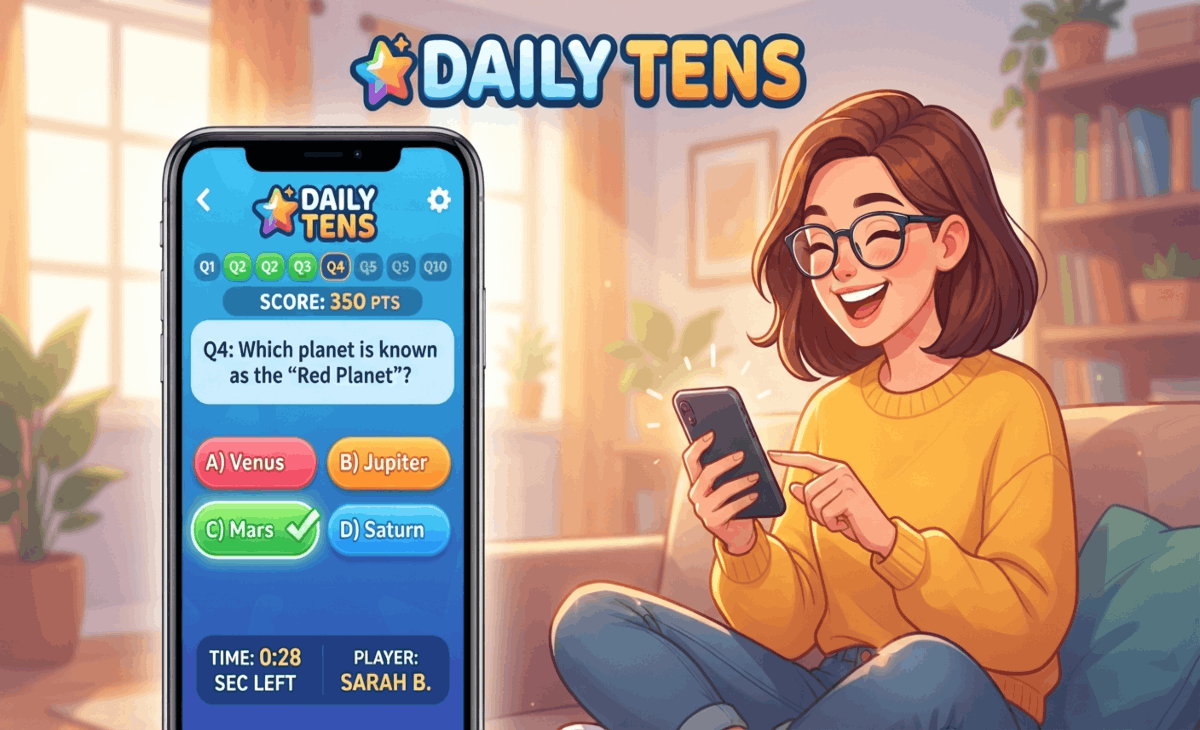
A short trivia game can still put your memory under pressure. Daily Tens does exactly that with a simple challenge: you get a category and try to name the ten answers that rank highest.
The idea sounds simple until one missing answer blocks your progress. That is where Daily Tens gets its appeal. Quick rounds, changing subjects, and a little pressure make each puzzle feel more challenging than it first appears. The format also makes the game easy to play with other people.
What Is Daily Tens?
Daily Tens is a web-based trivia game built around ranked lists. Each day presents one category, and the goal is to identify the ten items that belong at the top of that list.
The subjects can cover areas such as sports, films, geography, music, brands, history, and other public facts. One puzzle might focus on teams with the most wins, while another could ask about the largest countries, popular films, or best-selling products.
The basic idea is summed up by the question behind the game: can you find all ten answers today? Playlin also describes it as a daily trivia and knowledge game based around a single top-ten question.
How the Game Works
The rules are straightforward. Start by reading the category carefully. Then enter an answer and submit it. When the answer is correct, one of the ten empty positions is filled.
Incorrect guesses use up part of your attempt allowance. Daily Tens gives players up to five wrong guesses before the round ends. The challenge is therefore not only finding answers but deciding when an answer is strong enough to submit.
Some categories are based on a specific ranking measure, such as sales, population, victories, size, or another statistic. That measure matters. An answer can clearly belong to the category while still falling outside the top ten.
Why the Top Ten Format Feels Good
Ten is a useful size for a trivia challenge. It feels achievable without being completely obvious. Many players can think of one or two answers quickly, but the final spaces usually demand more careful recall.
Daily Tens also provides an immediate feeling of progress. Every correct answer removes one blank space. A round that begins slowly can suddenly improve when one useful memory triggers several others.
The format also has a natural ending. You know there are only ten positions to fill, so the game does not turn into a long series of questions or levels.
The Best Way to Start a Round
Avoid submitting the first name that seems connected to the topic. Take a few seconds to understand exactly what the category is asking.
Pay attention to the ranking rule. Is the list based on total sales, recent performance, land area, awards, population, or an all-time record? The wording can completely change which answers belong.
Begin with the strongest possibilities. On a sports question, think about teams with long records of success. On a geography question, start with places that clearly lead the relevant measurement. Playlin offers similar guidance by emphasizing the strongest leaders first because the game is about ranking, not simply matching a category.
Use Broad Groups Before Exact Names
One useful strategy is to organize the topic into groups before trying to recall individual answers. This can reduce random guessing.
If the category involves major cities, think by country or region. If it asks about films, consider studios, decades, franchises, or major releases. For music, you might divide your memories by genre, era, or international popularity.
Memory often works through connections. One city can remind you of another nearby city. One sports team can bring a famous opponent to mind. One film can trigger memories of related titles. Daily Tens benefits from this chain of recall because one answer can lead naturally to another.
Save Your Risky Guesses
Five incorrect answers can disappear quickly, so every uncertain guess should be treated carefully.
Use your strongest answers first. Save weaker possibilities until later, when the answers already on the board give you more information about what might still be missing.
If several obvious answers fail, stop and reread the category. You may be interpreting the ranking incorrectly.
For example, “most titles” is different from “most final appearances.” A question about current size may not have the same answers as an all-time ranking. Small wording differences can turn a reasonable guess into a wasted attempt.
Why Some Answers Are Hard to Find
The first few positions are often easier because they contain familiar names. The lower positions can be much harder.
People tend to remember famous winners, major brands, popular cities, and well-known figures. They may struggle to recall the item that ranks just below those obvious choices.
Older statistics can create another problem. Something that feels extremely important today may not rank highly across a longer period. A famous city may also have a smaller population than a less internationally recognized one.
That is what makes Daily Tens interesting. It takes something that feels familiar and turns it into a test of whether your memory matches the actual ranking.
You May Also like this: Classroom15X Guide: Games, Features, Benefits, and Safety
A Good Game for Short Breaks
Playlin describes the game as taking less than two minutes, although difficult categories can naturally keep players thinking for longer.
The short format makes Daily Tens suitable for a coffee break, a quick pause between tasks, or another small gap in the day. There is no lengthy setup and no need to commit to a large quiz session.
You simply open the game, read the daily category, and begin making guesses. The daily reset also creates a natural limit. One puzzle can become a small daily habit without demanding a large amount of time.
Playing With Friends and Family
Although Daily Tens works perfectly well as a solo game, it can become more entertaining when several people discuss the answers.
Two players can look at the same screen and debate possible guesses. Families can take turns submitting answers. Friends can also compare how many spaces each person manages to fill.
It helps to decide on the rules before starting. Everyone can agree on an answer before it is entered, or players can take individual turns. The first method encourages discussion, while the second makes each guess feel more personal.
The categories can also lead to conversations outside the game. A film question might bring up old favorites. A sports category can restart a friendly argument. The puzzle may end quickly, but the discussion often does not.
Common Mistakes to Avoid
The first common mistake is confusing a valid answer with a top-ten answer. An item can clearly fit the category without ranking highly enough to appear on the list.
The second mistake is overlooking the time period or measurement. Words such as “current,” “since 2000,” and “all time” can completely change the answer set. Read those details carefully before using a guess.
Another mistake is spending attempts on minor spelling variations. Enter the normal, commonly used name when possible. If one version fails, avoid repeatedly submitting tiny variations unless you are confident that the underlying answer actually belongs in the top ten.
Finally, do not panic when the board remains mostly empty. Daily Tens rewards patience. A lack of early answers does not mean you have no useful knowledge. Step back, divide the subject into groups, and approach the category again.
Daily Tens Is Not the Same as Daily 10 or TENS Therapy
Search results can sometimes mix several unrelated uses of similar terms. The Daily Tens discussed here is the trivia game based on daily top-ten lists.
“Daily 10” can also refer to a mental-maths activity from Topmarks. That activity provides primary-school students and teachers with ten short questions covering areas such as addition, fractions, rounding, multiplication, division, and number order.
“TENS” is also a medical abbreviation for transcutaneous electrical nerve stimulation. A TENS device uses a mild electrical current delivered through pads placed on the skin and may provide short-term pain relief for some people. It is a completely different subject from the trivia game.
For the game, check the page title and description before playing. The relevant format is the daily challenge asking players to identify the top ten answers.
Is the Game Worth Playing?
Daily Tens is a good option for people who enjoy general knowledge but do not want to spend a long time completing a quiz.
The rules are quick to understand, while the category can change from day to day. That means the same basic format can test knowledge across many different subjects.
The game can also be frustrating. One forgotten name or unexpected ranking can prevent a perfect result. But that difficulty is part of the appeal. The challenge is not just remembering facts; it is understanding the question, judging rankings, and managing limited guesses.
Most rounds are short. Some, however, can stay in your thoughts long after you close the page. For a game built around one category and ten answers, that is a surprisingly effective format.
Bottom Line
Daily Tens turns a simple ranked list into a compact daily trivia challenge. You get one subject, ten targets, and only a small number of mistakes to work with.
The best approach is to read the ranking carefully, start with the obvious leaders, organize the topic into broad groups, and protect your guesses. When the final few answers become difficult, slow down rather than guessing randomly.
Its design is simple, but that simplicity is part of what makes Daily Tens easy to understand and difficult to master.
