


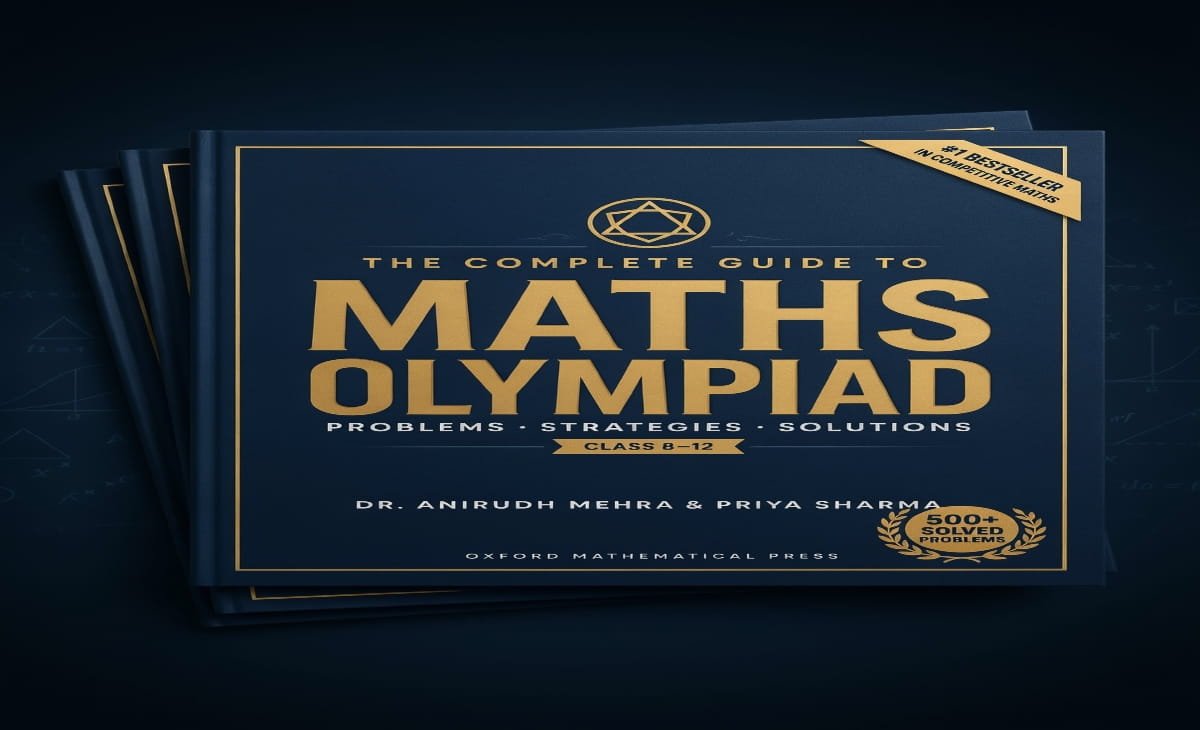
Maths becomes more challenging as students learn topics such as number patterns, algebra and shapes. To build stronger problem-solving skills, Maths Olympiad books offer questions that encourage logical thinking and a better understanding of mathematical concepts. These books help students recognise patterns, explore different methods and solve unfamiliar problems with confidence.
| Table of Contents
1. What Are Abstract Mathematical Concepts? 2. Why Abstract Maths Can Be Difficult for Students 3. How Maths Olympiad Books Develop Abstract Thinking 4. Maths Olympiad Books vs Traditional Maths Practice Books 5. How Parents Can Help Children Learn with Olympiad Books 6. Common Mistakes Students Should Avoid 7. Final Thoughts 8. Frequently Asked Questions |
What Are Abstract Mathematical Concepts?
Abstract mathematical concepts are ideas that students cannot always understand by counting or looking at objects. They need to use logical thinking, symbols and mathematical rules to solve problems.
For example, in algebra, students learn that letters can represent unknown numbers. In fractions, they learn how parts of a whole relate to percentages and ratios.
Common abstract maths concepts include:
- Algebra: Finding unknown numbers and understanding equations.
- Number patterns: Recognising patterns and rules in numbers.
- Spatial reasoning: Understanding and comparing shapes.
- Mathematical logic: Using reasoning to solve problems.
- Generalisation: Applying the same maths rules to different questions.
Learning these concepts helps students understand difficult maths topics and improve their problem-solving skills.
Why Abstract Maths Can Be Difficult for Students
Many students find maths easy when questions follow familiar steps. However, they may struggle with problems that require logical thinking and new approaches. Some students rely too much on memorised formulas without understanding how they work. Others find it difficult to understand word problems or imagine shapes without diagrams.
Regular practice with different types of questions helps students understand maths concepts, think independently and improve their problem-solving skills.
How Maths Olympiad Books Develop Abstract Thinking
Maths Olympiad books introduce questions that require students to investigate mathematical relationships rather than depend entirely on standard procedures. The following approaches explain how these books can support deeper mathematical understanding.
1. Encourage Students to Recognise Patterns
Pattern recognition helps students understand how numbers and shapes are connected. Maths Olympiad books include questions that encourage students to find patterns and rules.
For example, consider the sequence:
2, 6, 12, 20, 30, ?
The differences are 4, 6, 8 and 10. Since each difference increases by 2, the next difference is 12. Therefore, the missing number is 42.
- Develop Logical Reasoning Skills
Logical reasoning helps students use given information to find the correct answer. Maths Olympiad questions encourage students to think carefully and solve problems step by step.
For example:
A number is greater than 20 but smaller than 40. It is divisible by both 3 and 5. What is the number?
The correct answer is 30, as it meets all the conditions.
- Connect Mathematical Ideas to Practical Problems
Abstract maths becomes easier when students connect mathematical ideas to real-life situations. Maths Olympiad books include questions about sharing objects, measuring distances and arranging items.
For example, students may need to find different ways to arrange a group of objects. These questions encourage them to think carefully and explore different solutions. Such activities help students understand difficult maths concepts and improve their problem-solving skills.
4. Introduce Different Problem-Solving Strategies
Maths Olympiad questions can often be solved in different ways. Students may use diagrams, tables, number patterns or work backwards to find the answer.
Trying different methods helps students understand which approach works best. It also teaches them that maths problems do not always have one fixed method. With regular practice, students can improve their thinking skills and solve unfamiliar questions more confidently.
5. Strengthen Visualisation and Spatial Thinking
Spatial reasoning helps students understand shapes, sizes and positions. Maths Olympiad geometry questions may ask students to find hidden shapes, calculate angles or imagine rotated objects.
For example, students may need to count all the squares in a grid, including larger squares made from smaller ones. These activities improve observation, visual thinking and problem-solving skills. They also help students understand geometry and measurement more easily.
Maths Olympiad Books vs Traditional Maths Practice Books
Both Olympiad books and traditional practice materials contribute to mathematical development, but they often serve different purposes. Traditional assessment books generally help students reinforce curriculum topics, practise familiar question types and prepare for school examinations. Olympiad books place greater emphasis on unfamiliar problems that require reasoning, creativity and deeper conceptual understanding.
| Learning Aspect | Maths Olympiad Books | Traditional Practice Books |
| Main focus | Mathematical reasoning and problem-solving | Curriculum understanding and revision |
| Question style | Challenging and unfamiliar | Often structured around taught topics |
| Skills developed | Logic, pattern recognition and flexible thinking | Accuracy, fluency and method application |
| Learning approach | Exploring multiple strategies | Practising established methods |
| Difficulty level | Often extends beyond routine school questions | Usually aligned with school expectations |
| Best suited for | Students ready for mathematical challenges | Students strengthening foundational knowledge |
Neither type of book should completely replace the other. Students benefit from building strong mathematical foundations before progressing to increasingly complex problems. Using both resources appropriately can support a more balanced learning experience.
How Parents Can Help Children Learn with Olympiad Books
Parents can play an important role in helping children approach challenging mathematical questions with patience and confidence. The aim should be to encourage understanding rather than simply completing more exercises.
Choose books that match the child’s ability. Start with questions that are slightly more challenging than familiar school exercises. Extremely difficult problems may discourage students who are still developing foundational skills.
Encourage children to explain their thinking. Ask questions such as, “Why did you choose this method?” or “Can you find another way?” Explaining solutions helps children organise their reasoning.
Allow sufficient thinking time. Avoid providing answers immediately when children encounter difficulties. Offer small hints or suggest drawing a diagram if they become stuck.
Review mistakes together. Discuss incorrect solutions to identify misunderstandings. Encourage children to understand why an approach failed before attempting a different method.
Maintain a consistent routine. Short, focused practice sessions are often more manageable than completing many difficult questions at once.
Parents should also recognise progress in reasoning and persistence, not only the number of correct answers.
Common Mistakes Students Should Avoid
Although Olympiad books offer valuable learning opportunities, students may develop unhelpful habits if they focus entirely on obtaining correct answers. One common mistake is attempting advanced questions without understanding the underlying mathematical concepts.
Students should strengthen their knowledge of arithmetic, fractions, geometry and other relevant topics before tackling complex applications. Another mistake is checking solutions too quickly. Reading an answer without attempting the question limits opportunities to develop independent reasoning.
Students may also memorise solution methods without understanding why those methods work. To avoid these problems, students should practise explaining each step and revisit challenging questions after reviewing the solution. Consistent, thoughtful practice is generally more useful than rushing through large numbers of questions.
Final Thoughts
Maths Olympiad preparation encourages students to think beyond standard classroom methods and develop creative approaches to challenging problems. Exploring number patterns, logical puzzles and mathematical relationships can strengthen analytical thinking and improve reasoning abilities.
Students can benefit from educational resources offered by Singapore Asia Publishers, particularly materials that provide progressive exercises and opportunities to apply mathematical concepts in different situations. By combining challenging questions with thoughtful guidance and regular reflection, students can sharpen their problem-solving techniques, develop greater flexibility in their thinking and build confidence in tackling unfamiliar mathematical challenges.
Frequently Asked Questions
1. Are Maths Olympiad books suitable for primary school students?
Yes. Many Olympiad books are designed for primary school students and include age-appropriate reasoning questions. Parents should choose materials based on their child’s mathematical ability rather than age alone.
2. Can Maths Olympiad books improve school maths performance?
They can support school mathematics by strengthening reasoning, pattern recognition and problem-solving skills. However, students should also practise curriculum-based questions to develop accuracy and examination familiarity.
3. How often should students practise Olympiad maths questions?
Students can begin with two or three short sessions each week. The ideal frequency depends on their ability, school workload and interest. Understanding solutions is more important than completing many questions.
4. What mathematical skills are developed through Olympiad practice?
Olympiad practice can develop logical reasoning, spatial visualisation, pattern recognition, mathematical creativity and the ability to solve unfamiliar problems using different strategies.
5. Should students use Olympiad books without a tutor?
Some students can work independently, particularly when books provide clear explanations. However, guidance from parents, teachers or tutors can help when students struggle with difficult concepts or need support understanding alternative solutions.
