

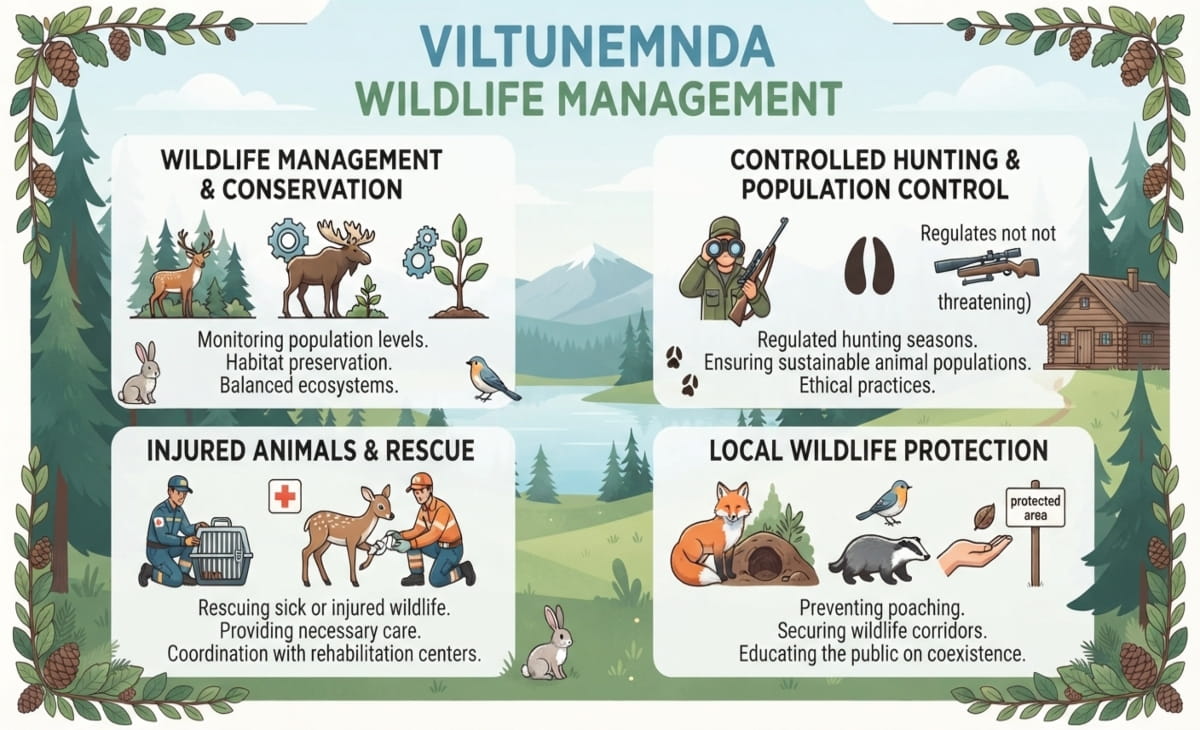
Viltnemnda is a Norwegian term connected with local wildlife management. People may encounter the word when searching for information about hunting, deer management, injured wild animals, wildlife collisions, or other wildlife-related matters in Norway.
The exact system is not organized in exactly the same way in every municipality. Some municipalities use a formal wildlife committee, while others handle similar responsibilities through municipal employees, wildlife contacts, fallvilt groups, or local tracking teams.
This guide explains what Viltnemnda means, how the system has changed, what responsibilities can be connected with it, and how it relates to hunting, injured wildlife, road accidents, and local wildlife management.
What Is Viltnemnda?
Viltnemnda can be translated as “the wildlife committee” or “the wildlife board.” The term is associated with wildlife management at the municipal level in Norway.
The Norwegian word has two main parts. Vilt refers to wildlife or game animals, while nemnd means a committee, board, or official panel. Viltnemnda is the definite form, giving it the approximate meaning “the wildlife committee.”
It is important to understand that Viltnemnda is not one national organization responsible for wildlife management throughout Norway. Local wildlife management is handled at the municipal level, and the way the work is organized can vary.
Some municipalities may still have a formal viltnemnd. Others may use municipal wildlife employees, a wildlife contact, a fallvilt group, or a tracking team.
Viltnemnda should also not be confused with an animal shelter or wildlife rescue charity. Its role is mainly associated with public wildlife management, hunting, safety, injured wildlife, and legal wildlife matters.
How Viltnemnda Has Changed Over Time
Viltnemnda has a long connection with local wildlife management in Norway. Historically, municipal wildlife committees had a more clearly defined role within wildlife law.
According to the collected information, legal wording changed in 1992 so that responsibility was placed more directly on municipalities. Historical municipal information indicates that this change took effect around 1993.
This helps explain why the system can look different today. A municipality does not necessarily need an organization officially called Viltnemnda to carry out its local wildlife responsibilities.
The work may instead be handled by municipal employees, appointed committees, hunters, wildlife contacts, tracking teams, or combinations of these.
The collected information also identifies a major recent legal development. Norway’s former Viltloven, or Wildlife Act, was repealed on July 1, 2026, and replaced by Viltressursloven. The newer law covers matters involving wildlife resources, hunting, trapping, and culling. Municipalities continue to have an important role in local wildlife management under the current system.
Because wildlife law and local arrangements can change, anyone dealing with a specific situation should check current information from the relevant municipality or Norwegian authority.
How Local Wildlife Management Works
Norway has national wildlife laws and regulations, but many practical wildlife matters are handled locally.
This approach is useful because wildlife conditions differ significantly between municipalities. One area may have large moose populations, while another may deal more frequently with red deer or roe deer.
Forests, farmland, roads, towns, and wildlife habitats also vary from one location to another. Local management can therefore take the particular conditions of an area into account.
Authorities may consider animal numbers, hunting results, road accidents, damage to crops or forests, and reports involving sick or injured wildlife.
The system has to balance several interests. Wildlife populations should remain healthy, but authorities may also need to consider road safety, farming, forestry, hunting, land use, biodiversity, and animal welfare.
This local structure is one reason the term Viltnemnda can mean slightly different things depending on the municipality.
Main Responsibilities of Viltnemnda
Responsibilities connected with Viltnemnda can include both administrative and practical wildlife work.
On the management side, municipalities may deal with wildlife population goals, hunting areas, harvest plans, permits, wildlife information, and local wildlife funds.
On the practical side, wildlife personnel may respond when an animal is injured or when a vehicle hits a moose or deer. Trained trackers and dogs can be organized to locate an animal that has escaped after being injured.
Another important concept is fallvilt. This term is associated with wild animals that are found dead, injured, or otherwise outside normal hunting circumstances. Recording such incidents can help authorities understand wildlife populations and accident patterns.
Viltnemnda-related work can also involve conflicts between humans and wildlife. Large wildlife populations, for example, can damage farms or forests or increase the risk of traffic accidents.
However, the exact division of responsibilities is not identical everywhere. Some tasks may be handled directly by municipal staff, while others may belong to a committee, tracking group, or different authority.
Moose, Deer, and Roe Deer Management
Moose, red deer, and roe deer are particularly important in Norwegian local wildlife management.
Municipalities can have responsibilities involving population goals, hunting areas, management plans, harvest permits, and the collection of information about local deer populations.
The objective is not simply to increase or decrease animal numbers. Wildlife managers need to maintain a reasonable balance between populations and the environment in which they live.
If a population becomes too large for an area, damage to forests and farms can increase. Wildlife collisions can also become more common.
On the other hand, populations that become too small can create different long-term management concerns.
Hunting, Quotas, and Permits
Hunting is another important part of local wildlife management.
The collected information shows that municipalities have significant responsibilities concerning species such as moose, red deer, and roe deer. This can involve approved hunting areas, population plans, harvest permits, and local reporting requirements.
Hunters may therefore interact with their municipality when managing an approved hunting area, receiving harvest allocations, following a population plan, or submitting hunting results.
Local conditions can influence these decisions. Wildlife numbers, available habitat, agricultural or forest damage, road safety, and long-term population objectives may all be relevant.
However, Viltnemnda does not have unlimited control over hunting. National laws and regulations still apply, and the exact powers of a local committee depend on how the municipality has organized and delegated its responsibilities.
What Is a Fellingstillatelse?
A fellingstillatelse is a permit allowing a specified number of animals to be legally harvested or killed under applicable rules.
It is different from an individual’s hunting license. A hunting license concerns the person’s right to hunt, while a fellingstillatelse is generally connected with permission to harvest animals within an approved hunting area or management arrangement.
Another related term is skadefellingstillatelse, meaning a damage-control culling permit. It may apply when wildlife is causing, or is likely to cause, serious damage.
The responsible authority can vary according to the species and reason for the request. Some cases can involve a municipality, while others may require a higher authority. Preventive measures may also need to be considered before an animal is killed.
Injured Wildlife and Viltnemnda
Injured wildlife is one of the situations in which members of the public may encounter the local wildlife management system.
A moose can be injured in a road accident. A deer can become caught in a fence. An animal can also be seriously injured during hunting or discovered with signs of severe illness or injury.
The local wildlife service may send trained personnel to locate and assess the animal. Depending on the circumstances, they can search for it, protect people from danger, assess its condition, and record the incident.
If an animal is severely injured and cannot recover, qualified personnel may need to humanely put it down. The objective is to prevent unnecessary suffering while also protecting public safety.
Members of the public should not chase, capture, or attempt to kill an injured moose or deer themselves. A frightened or injured large animal can be dangerous, and following it can make a later tracking operation more difficult.
The safer response is to maintain distance and report the situation to the appropriate authorities.
You May Also like this: Lucipara: Remote Islands, Diving, Wildlife, History, and Travel Guide
What to Do After Hitting a Wild Animal in Norway
If you hit a wild animal while driving in Norway, first stop somewhere safe. Turn on your hazard lights and make sure approaching traffic can see you.
Check whether anyone in the vehicle is injured. If someone requires urgent medical assistance, call 113.
For the wildlife collision, contact the police on 02800. Provide your location, the road you are traveling on, your direction of travel, and the type of animal involved.
The police can contact the appropriate local wildlife team.
If the animal runs away, mark the location where it left the road. This can give a tracking team a useful starting point.
Do not follow an injured moose, deer, or another large wild animal into the forest. It can be dangerous, and walking over tracks can make the search more difficult.
Remain available by phone if the police or wildlife personnel need additional information.
Tracking Injured Wildlife
Ettersøk means a search or tracking operation for an injured animal. It is commonly needed when an animal runs away after being struck by a vehicle or wounded during hunting.
An ettersøksjeger is a trained person who searches for wounded wildlife, potentially working with an approved tracking dog.
The tracker and dog can use footprints, scent, blood, hair, and other signs to locate the animal. The goal is to find it as quickly and safely as possible.
A tracking team can be used following a road collision, hunting injury, report of a seriously injured animal, suspected illness, or an animal becoming trapped.
This is another reason members of the public should not follow an injured animal. Leaving the area undisturbed can make it easier for trained personnel and dogs to follow the trail.
What Is Fallvilt?
Fallvilt is an important Norwegian wildlife-management term.
In formal wildlife rules, it refers to wildlife that has died outside normal legal hunting, trapping, or licensed culling. Municipal wildlife services may also use the term more broadly when discussing sick, injured, or dead wild animals.
For example, fallvilt can include an animal that dies after a road collision, is discovered dead in nature, dies from disease, or has to be put down because of serious injuries.
This means fallvilt is broader than roadkill. A traffic accident is only one way an animal can become fallvilt.
Hjorteviltregisteret
Some fallvilt cases can be recorded in Hjorteviltregisteret.
This national database contains information concerning species such as moose, red deer, roe deer, and wild reindeer. It also contains information about hunting, wildlife populations, and selected fallvilt cases.
Such records can help wildlife managers understand where accidents occur and how wildlife populations change over time.
Viltnemnda and the Police
The police and local wildlife teams connected with Viltnemnda have different responsibilities.
The police can receive reports about wildlife collisions and deal with immediate public or traffic safety concerns. They can then contact the appropriate municipal wildlife service.
The local wildlife team provides practical wildlife expertise. It may send trained personnel, trackers, and approved tracking dogs to the location.
The process can broadly look like this:
Driver or witness → Police → Local wildlife team → Tracker and dog → Search and report
This arrangement makes reporting easier for the public because a driver does not normally need to find the correct local wildlife worker while dealing with an accident.
Wildlife Damage and Conflicts With People
Wildlife can sometimes create problems for people.
Deer and other animals may damage crops, forests, gardens, or property. Large animals near busy roads can also create significant safety concerns.
Local wildlife authorities can assess the situation and determine what action may be appropriate. The response depends on the species, type of damage, and relevant laws.
Preventive measures may be considered first. In certain circumstances, hunting or damage-control culling can be used.
More serious or unusual cases may require decisions from authorities other than the municipality.
The purpose of wildlife management is not simply to remove animals. Authorities also need to consider healthy wildlife populations, biodiversity, animal welfare, property, and public safety.
Dogs and Extra Leash Rules
Dogs can disturb wildlife, particularly during breeding periods or difficult winter conditions.
Norway has general rules concerning the control of dogs, and municipalities can also establish local leash requirements.
The collected information gives examples in which a local Viltnemnda has authority to introduce extraordinary leash requirements when particular conditions make them necessary. Eidsvoll and Vågan are mentioned as examples.
Deep snow is one situation in which additional protection may be useful. Wild animals already expend more energy moving through deep snow, and being chased by a dog can place additional stress on them.
These local measures are generally connected with specific circumstances rather than being permanent rules throughout Norway.
How Hunters and Landowners Work With the System
Hunters can interact with municipal wildlife management for several reasons. These include approved hunting areas, harvest permits, population plans, and reporting hunting results.
Information provided by hunters can also help authorities understand changes in local wildlife populations.
Landowners and farmers may have different reasons for engaging with the system. A large deer population, for example, can cause damage to crops, young trees, and forests.
Wildlife management therefore has to consider several groups. Hunters need clear hunting rules, landowners may need help dealing with wildlife damage, and the wider community needs safe roads and healthy wildlife populations.
Why Viltnemnda Can Have Different Names
Readers should not assume that every Norwegian municipality has a service using the exact name Viltnemnda.
Some municipalities continue to use the traditional term. Others organize similar work through municipal employees or separate wildlife and tracking teams.
Useful related Norwegian terms include:
- Viltforvaltning — wildlife management
- Fallvilt — fallen, injured, or dead wildlife
- Fallviltgruppe — local fallvilt response team
- Ettersøk — search or tracking
- Viltkontakt — wildlife contact
- Viltpåkjørsel — wildlife-vehicle collision
Someone searching for help after finding an injured deer, for example, may find a municipal webpage under fallvilt rather than Viltnemnda.
For this reason, the official website of the relevant municipality is generally the best place to find current information and contact details.
Important Norwegian Wildlife Terms
Understanding several Norwegian terms can make information about Viltnemnda much easier to follow.
| Norwegian term | Easy English meaning |
| Viltnemnd | Wildlife board or committee |
| Viltnemnda | The wildlife board or committee |
| Viltforvaltning | Wildlife management |
| Fallvilt | Fallen, injured, or dead wildlife |
| Fallviltgruppe | Local fallvilt response team |
| Ettersøk | Search or tracking operation |
| Ettersøksjeger | Wounded-wildlife tracker |
| Ettersøkshund | Tracking dog |
| Viltpåkjørsel | Wildlife-vehicle collision |
| Fellingstillatelse | Harvest or culling permit |
| Skadefelling | Damage-control culling |
| Hjortevilt | Deer species group |
| Vald | Approved hunting management area |
Some Norwegian wildlife terms do not have one exact English equivalent. Their meaning can depend on the context in which they are used.
Why Local Wildlife Management Matters
Local wildlife management affects far more people than hunters.
Road safety is one major reason. Moose and deer can cause serious traffic accidents. Prompt reporting and trained tracking teams can help locate injured animals and reduce additional risks.
Animal welfare is another important consideration. A badly injured wild animal may suffer for an extended period if nobody reports the incident. Local wildlife personnel can search for the animal and determine what action is required.
Farmers and forest owners are also affected by wildlife populations. Excessive numbers of animals in an area can increase damage to crops and trees.
At the same time, wildlife populations need to remain healthy. Local management can use hunting information, fallvilt records, population data, and local knowledge when making decisions.
Viltnemnda and related municipal services therefore connect residents, hunters, landowners, police, wildlife trackers, and local authorities within the broader wildlife-management system.
Bottom Line
Viltnemnda is a Norwegian term that generally means wildlife committee or wildlife board. Today, it is best understood as part of Norway’s local wildlife-management system rather than as one national organization.
Its exact form can vary between municipalities. Related work may involve deer management, hunting plans and permits, injured wildlife, tracking operations, fallvilt, wildlife collisions, and conflicts between people and animals.
For members of the public, one of the most important points is straightforward: do not approach or chase seriously injured large wildlife. Report the situation to the appropriate authorities and allow trained wildlife personnel to handle it.
Frequently Asked Questions
What does Viltnemnda mean in English?
Viltnemnda means “wildlife committee” or “wildlife board.” It is associated with local wildlife management in Norway.
Is Viltnemnda a national agency?
No. Viltnemnda is connected with local municipal wildlife management rather than being one national agency.
Does every Norwegian municipality have a Viltnemnda?
No. Some municipalities use a formal wildlife committee, while others organize the work through municipal wildlife staff, wildlife contacts, or local tracking teams.
What does Viltnemnda do?
Depending on the municipality, work associated with Viltnemnda can include wildlife management, hunting matters, injured animals, tracking, fallvilt, and local wildlife populations.
Who should I call after hitting a deer or moose in Norway?
The reference information says to contact the police on 02800 after a wildlife collision. If someone needs urgent medical assistance, call 113.
What is an ettersøksjeger?
An ettersøksjeger is a trained person who tracks injured or wounded wild animals, potentially with the help of an approved tracking dog.
What does fallvilt mean?
Fallvilt generally refers to wildlife found dead, injured, or sick outside normal hunting, trapping, or licensed culling.
Is Viltnemnda an animal rescue service?
No. Its role is primarily connected with wildlife management, safety, tracking, and the handling of injured wild animals rather than operating as an animal shelter or wildlife rescue charity.
