


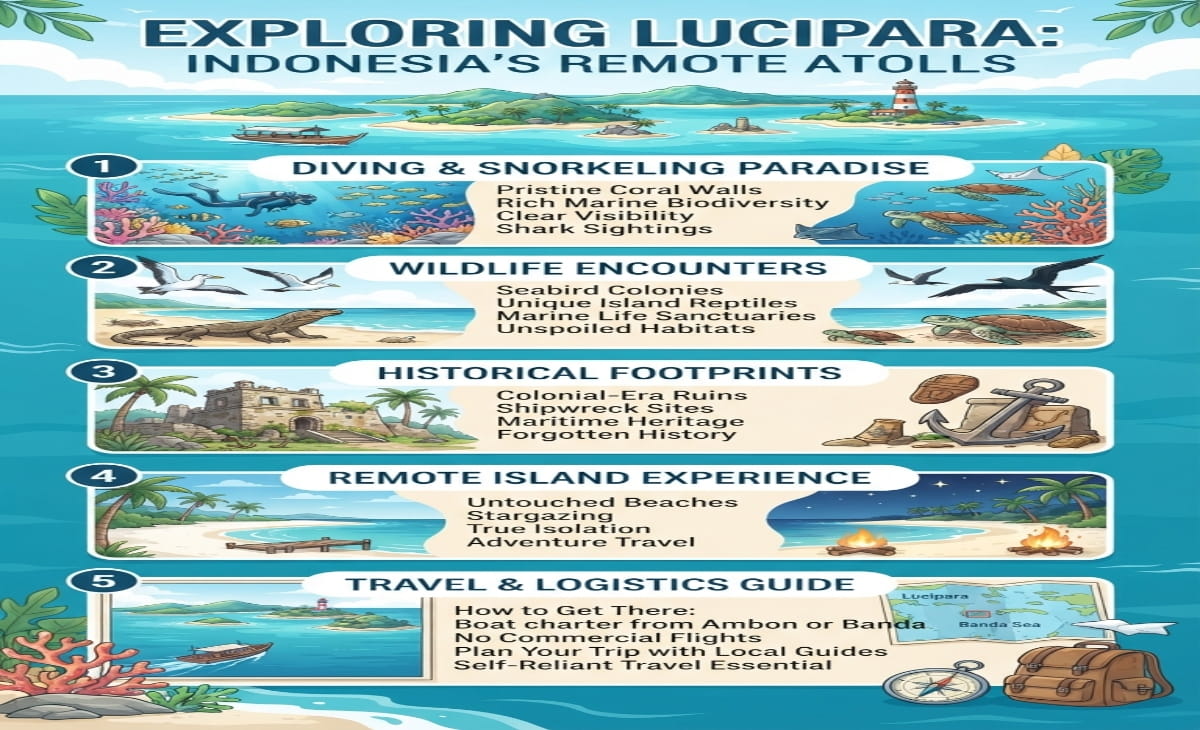
Lucipara is a remote group of small islands and reefs in Indonesia’s Banda Sea. Far from major resorts, large ports, and common tourist routes, the area is known for clear water, steep reef walls, sea turtles, and an unusually strong sense of isolation.
The islands form part of the wider Maluku Islands, also known as the Moluccas. Their remote location means visiting Lucipara is very different from taking a conventional Indonesian beach holiday. Most travelers reach the area by boat, often as part of a longer liveaboard expedition.
Where Are the Lucipara Islands?
The Lucipara island group sits in the central Banda Sea, south of Ambon and west of the Penyu Islands. Open ocean surrounds the small islands and reefs for considerable distances, giving the region a very different atmosphere from Indonesia’s heavily visited coastal destinations.
According to an expedition report from The Seven Seas, Lucipara is approximately 200 kilometers south of Ambon. One expedition took about 15 hours by boat to reach the area, although the actual journey can vary depending on the vessel, route, weather, wind, and sea conditions.
The islands are also associated geographically with the Penyu Islands, Ceram, and the Manipa Strait region. Their position places them within one of eastern Indonesia’s most remote and dramatic marine environments.
Why Is Lucipara So Remote?
Lucipara does not have the normal infrastructure found at established tourist islands. There are no towns, airports, hotels, or conventional ferry terminals serving visitors.
A 2021 expedition report stated that nobody was living permanently on the islands at that time. Some families reportedly maintained traditional claims to the area and returned occasionally to collect coconuts.
This absence of permanent tourism infrastructure affects everything about a visit. Travelers need a vessel capable of providing accommodation, meals, drinking water, fuel, safety equipment, and other basic necessities.
Weather also plays an important role in reaching Lucipara. The Seven Seas notes that access is possible during limited periods around changes in the monsoon. This helps explain why organized sea expeditions and liveaboard trips are the most practical way to explore the islands.
The Undersea Mountains Below Lucipara
Although the islands themselves are small, the underwater landscape surrounding them is much larger. The Seven Seas describes the tiny atolls as the visible tops of underwater mountains rising more than a mile from the ocean floor.
This unusual geological structure creates steep underwater slopes. Divers can move from shallow coral reef into deep blue water over a relatively short distance.
The broader Banda Sea is also extremely deep, with some areas reaching several thousand meters. Deep basins, underwater ridges, isolated reefs, and small islands combine to create an environment capable of supporting a wide variety of marine life.
For divers, the result is one of the most dramatic features of Lucipara: a reef can appear shallow and bright at the surface before dropping rapidly into deep ocean.
Sea Turtles and Nesting Beaches
Sea turtles are among the most important natural attractions associated with Lucipara. The islands have long been recognized for turtle activity, particularly green turtles.
The quiet sandy beaches provide nesting areas away from major settlements and large concentrations of tourists. During a 2019 visit, marine scientist Lida Pet Soede recorded 470 green and hawksbill turtles across 14 snorkel sessions. More than 80 percent of those sightings were green turtles.
The expedition also recorded numerous nesting tracks across the white sand beaches. These observations highlight the ecological importance of the islands even though they remain relatively undeveloped.
The same report said local authorities had identified the area for marine protected status. However, marine debris was also identified as a threat, with trash appearing on some nesting beaches.
Diving Around Lucipara
Diving around Lucipara is largely about clear water, healthy hard coral, steep walls, and the open-ocean environment.
The underwater slopes allow divers to travel from bright shallow reef areas toward deep water very quickly. The Seven Seas describes strong hard coral, good visibility, and wall diving along the Banda Sea route.
One particularly unusual sight is the flashlight fish, scientifically known as Photoblepheron bandanensis. These fish are especially interesting during night dives because of their distinctive light-producing organs.
Sharks and turtles may also be encountered around the reefs. A 2019 expedition recorded blacktip reef sharks, grey reef sharks, and numerous turtles during snorkeling sessions.
As with any wild marine environment, sightings depend on conditions. Season, currents, visibility, and natural animal movements can all influence what divers see on a particular day.
Why Liveaboards Are the Main Way to Visit
A liveaboard essentially functions as a floating hotel and expedition base. The vessel provides sleeping accommodation, food, drinking water, diving equipment, and support while moving between remote sites.
This arrangement is especially useful for Lucipara because there are no established visitor services on the islands themselves.
Some journeys begin in Ambon and include Lucipara as one stop on a broader Banda Sea itinerary. Other routes combine the area with diving locations around the Banda Islands and other remote parts of Maluku.
Visitors should therefore think of Lucipara as a genuine sea expedition rather than a short transfer from a resort. Weather and monsoon conditions can change an itinerary, and operators may alter dive locations when currents, waves, or other conditions become unsuitable.
You May Also like this: Jacelyn Reeves: Clint Eastwood’s Former Partner and the Mother of Scott and Kathryn Eastwood
Fishing in Lucipara Waters
Lucipara’s offshore reefs and steep underwater structures also attract anglers interested in powerful tropical fish.
Fishing expedition reports mention species including giant trevally, dogtooth tuna, barracuda, yellowfin tuna, triggerfish, and other reef fish.
Giant trevally commonly hunt around reef edges, channels, and shallow flats, while dogtooth tuna are more closely associated with deep outer reef areas and steep underwater structure.
Anglers may use techniques such as popping, jigging, and saltwater fly fishing. Tidal movement is another important factor. Fishing operators report stronger activity around changes in tide as water moves through reef channels and across shallow areas.
Even with favorable conditions, fishing results can vary considerably from one day to another.
The Willem I Shipwreck of 1837
Lucipara also has a fascinating connection with Dutch colonial maritime history.
In May 1837, the Dutch steamship Willem I struck a reef while traveling toward Ambon. People aboard managed to escape onto a small dry section of the reef.
Historical accounts state that approximately 140 people were involved. Among them were acting Moluccas governor François Vincent Henri Antoine de Stuers, his wife and children, other passengers, soldiers, and members of the crew.
The group reportedly remained stranded on the reef for 37 days before being rescued.
The incident became notable enough to appear in later maritime records, books, and artwork associated with the shipwreck. A Dutch biographical record also states that De Stuers’ wife gave birth to a daughter during the ordeal.
This history gives Lucipara another dimension beyond its reefs and marine wildlife.
What Wildlife Can Visitors See?
The most significant wildlife observations around Lucipara concern marine species.
Green turtles and hawksbill turtles are among the most notable animals recorded in the area. Reef sharks can also be encountered around both shallow and deeper reef environments.
Divers may see pelagic fish traveling along walls and current lines. Fishing expeditions report species such as giant trevally, tuna, barracuda, coral trout, and triggerfish.
The exact wildlife experience depends on depth, tide, season, visibility, and natural animal behavior.
Lucipara should not be approached like a wildlife park with guaranteed viewing locations. These are wild animals living in open marine habitats, so even a well-planned expedition cannot promise that a particular species will appear.
When Is the Best Time to Visit Lucipara?
The Banda Sea experiences significant seasonal weather patterns. The Seven Seas identifies May through November as the drier period across the wider region, while December through April is generally wetter.
Monsoon winds can have a major effect on travel and diving conditions. The same operator identifies October to December and March to April as strong periods for diving in the wider Banda Sea.
However, visiting Lucipara is not simply a matter of choosing the months with the most sunshine. The exact route, wind, waves, currents, and conditions during the long journey from Ambon can all affect whether an expedition can safely reach particular sites.
For that reason, travelers should follow the operating schedule and advice of an experienced liveaboard company familiar with the Banda Sea.
Why These Islands Matter for Conservation
Lucipara demonstrates that even extremely remote places can experience environmental pressure.
Plastic and other marine debris can travel long distances through ocean currents and eventually accumulate on isolated beaches. A field report from the islands found significant amounts of trash near some turtle nesting areas.
The nesting beaches give Lucipara clear ecological importance, while coral reefs, reef fish, sharks, turtles, and offshore predators all form part of a connected marine food web.
Protecting the islands and surrounding waters can therefore benefit multiple species at the same time.
Visitors can help by following local conservation rules, avoiding disturbance of nesting turtles, and keeping waste aboard their vessels. Dive operators and fishing expeditions also have an important responsibility to minimize damage while allowing carefully managed access to the area.
Conclusion
Lucipara remains one of the more isolated marine destinations in eastern Indonesia. Its appeal comes from deep ocean, steep coral reefs, turtle nesting beaches, abundant marine life, and the long journey required to reach it.
This is not a conventional island vacation. There are no beach clubs, city tours, airports, or easy transport connections waiting for visitors. Instead, travelers come for diving, fishing, wildlife, history, and the rare experience of being far away from crowded tourism routes.
The story of the Willem I shipwreck adds an important historical layer to the islands, while their reefs and turtle beaches give the region its strongest modern appeal.
For travelers prepared for a genuine sea expedition, Lucipara offers a very different perspective on Indonesia and the remote marine world of the Banda Sea.
